
Failure & inspection
Brake Shoe Holder and Beam End: Failure Causes and Limits
Brake shoe holders and beam ends fail from fatigue, wear and thermal cracking. Learn which crack location condemns the holder and why matched sets must be.
Published: · Last updated: · Reviewed by Fan Yaoqiang
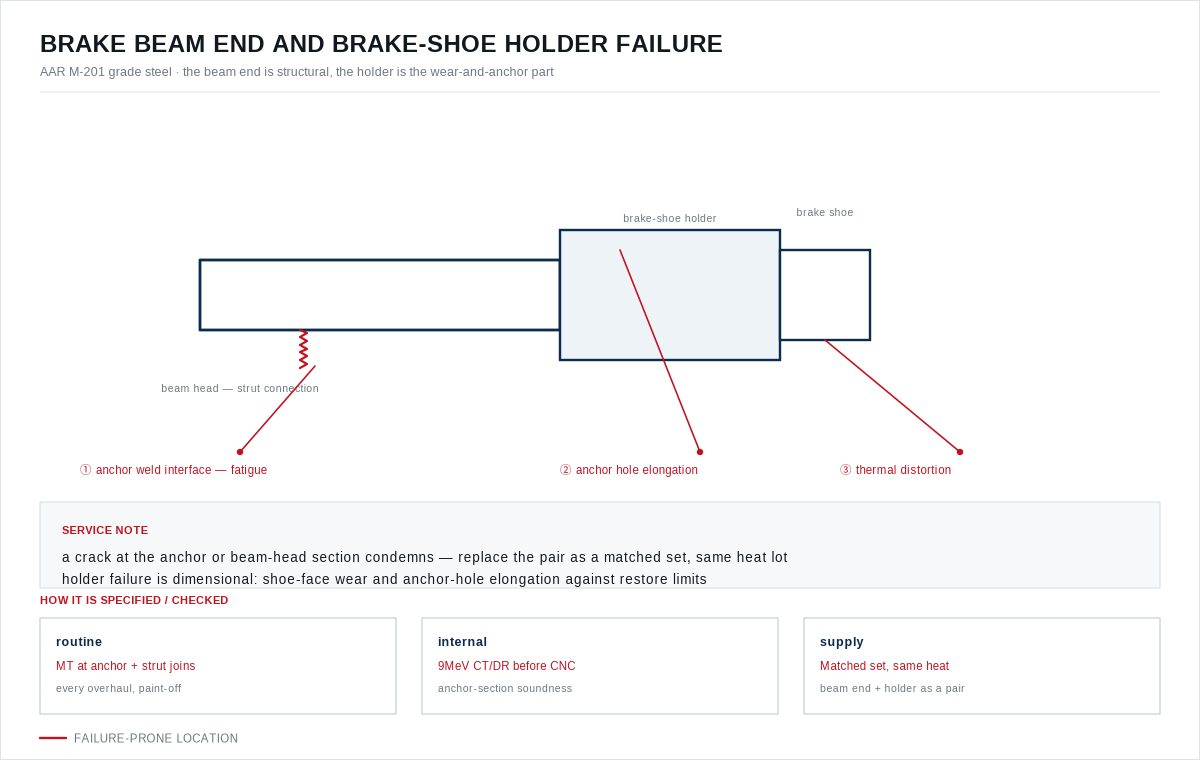
Brake shoe holders and brake beam ends fail from three causes: fatigue at the anchor, wear at the shoe interface, and thermal cracking from repeated braking. A holder that cracks at the anchor is condemned outright; a beam end that distorts from heat is replaced as a structural member. SIMIS casts both as matched brake-system components to AAR M-201 steel grades.
Brake Shoe Holder versus Beam End
| Aspect | Brake shoe holder | Brake beam end |
|---|---|---|
| Role | Carries the brake shoe at the anchor | Structural beam across the bogie |
| Dominant failure | Wear, anchor-hole elongation | Fatigue, heat distortion |
| Condemn driver | Restore limit at shoe interface | Crack or distortion at section |
| Replacement | With the beam end, as a set | With the holder, as a set |
The two are designed as a pair: the holder is the wear-and-anchor part, the beam end is the load-carrying member.
Technical Mechanism: Load Paths and Failure Origins
The brake beam end carries the braking force from the cylinder to the shoes through its column and anchor connections. AAR M-201 sets the casting grade for these steel parts, and the anchor weld interface and the column connection are the stress concentration points where fatigue cracks start under reversing brake load.
The shoe holder sits at the anchor and presents the wear face to the brake shoe. Its failure is dominated by dimensional loss — the shoe interface wears and the anchor hole elongates under repeated shoe clamping. Thermal cracking appears on the beam end when a long descent keeps the brake applied; the heat distorts the section rather than wearing it. Because the load paths differ, the condemn limits differ: a crack in the beam end section condemns it, while the holder is condemned by wear past its restore limit or by an anchor crack.
Production Equipment and Process Control
Both parts are poured on the German HWS V-process vacuum sand casting line, which holds the anchor bore and the beam-end section to the dimensional stability the braking geometry needs. EBT + LF duplex refining limits the inclusions that would seed a fatigue crack at the anchor or column.
Each casting is verified by 9MeV industrial CT/DR volumetric scanning — critical for the anchor section where internal porosity condemns the part at incoming inspection — and by UT/MT/PT before CNC machining. Normalising and tempering delivers the toughness the reversing brake load demands, with furnace records tied to the heat number.
Inspection, Acceptance and Traceability
Every holder and beam end ships with the factory material certificate, fully compliant with EN 10204 3.1, a heat number and an individual serial number. NDT reports are filed against that serial so a depot can trace a cracked or worn part back to its melt and inspection record.
Because the two are a matched set, SIMIS supplies them against the same heat lot and bogie type the fleet runs, so the anchor fit is correct when the pair is fitted together at the depot.
Typical Failure Modes and Detection Methods
Brake beam components fail from fatigue at the anchor, from wear at the shoe interface, and from thermal cracking. This table maps each failure mode to its location, detection method and the usual component replacement decision.
| Failure mode / rejection condition | Consequence or cause | Detection method | Disposition |
|---|---|---|---|
| Anchor crack | At the brake beam anchor weld interface | Magnetic particle | Replace the beam end, not the shoe holder |
| Shoe interface wear | On the wear face of the shoe holder | Dimensional measurement | Replace or re-machine, below the restore limit |
| Bolster collar crack | At the brake beam column connection | Magnetic particle | Replace the beam end |
| Heat distortion | Across the beam end section | Dimensional measurement | Replace the beam end |
| Anchor hole elongation | In the shoe holder | Dimensional measurement | Replace the shoe holder |
| Internal porosity | In the anchor section | 9MeV industrial CT | Reject at incoming inspection |
Important. Brake beam ends and brake shoe holders are supplied as matched sets. Replacing one component of a pair with a casting from a different heat lot changes the fit; this is a common cause of early failure.
FAQ
Which crack location condemns a brake shoe holder?
The condemning crack is at the anchor section or the anchor hole, where fatigue from the brake load concentrates. Magnetic particle and dimensional checks at the anchor pick it up; an elongated anchor hole or a crack at the shoe interface below the restore limit also condemns the holder. A crack anywhere in the load path means reject, not repair.
How do beam end and shoe holder fail differently?
The beam end fails from fatigue at the anchor weld interface, at the column connection and from heat distortion across its section; the shoe holder fails from wear at the shoe interface and from anchor-hole elongation. The beam end is a structural member, the holder is a wear-and-anchor part, so their condemn limits differ.
How should matched sets be replaced on a wagon?
Replace the beam end and the shoe holder as a matched set from the same heat lot. Mixing a new holder with a beam end from a different heat changes the fit and is a common cause of early failure, so the pair should be ordered and fitted together rather than one component at a time.
Related
CTA
Send your brake beam and shoe holder drawing with the bogie type to sales@simisrail.com. SIMIS confirms receipt within 1 working day and returns a quotation within 3 working days, stating heat-lot pairing, indicative lead time and MOQ.
Technical Review
For a question on brake shoe holder and beam end failure, contact Felix at sales@simisrail.com or +86-13934165890.