
Failure & inspection
Common Casting Defects in Railway Parts and Prevention
Railway castings are rejected for a handful of recurring defects. See the cause, location and detection method for gas porosity, shrinkage, sand inclusion.
Published: · Last updated: · Reviewed by Wang Yan
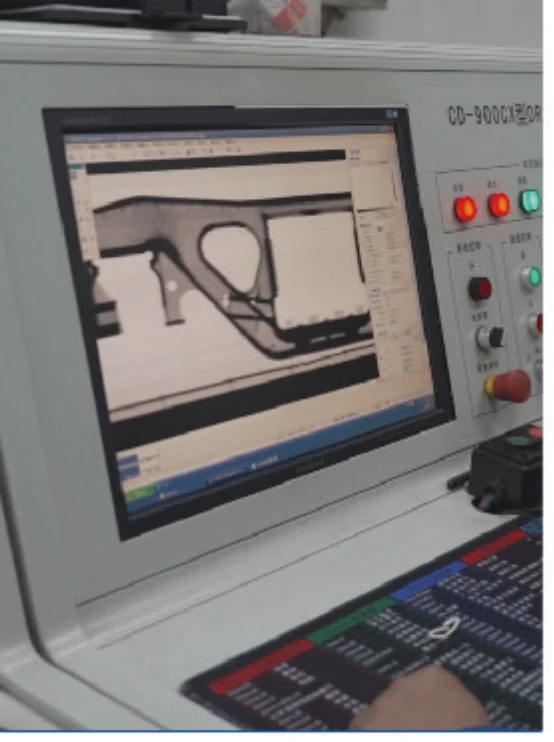
Railway castings are most often rejected for a small set of recurring defects: gas porosity, shrinkage cavities, sand inclusions, cold shuts, hot tears and misruns. Each defect forms at a predictable location and is found by a specific method — 9MeV industrial CT for internal voids, magnetic particle for surface cracks, and dimensional checks for distortion. SIMIS controls these through the German HWS V-process line, EBT+LF refining and 100% volumetric scanning on critical bogie parts.
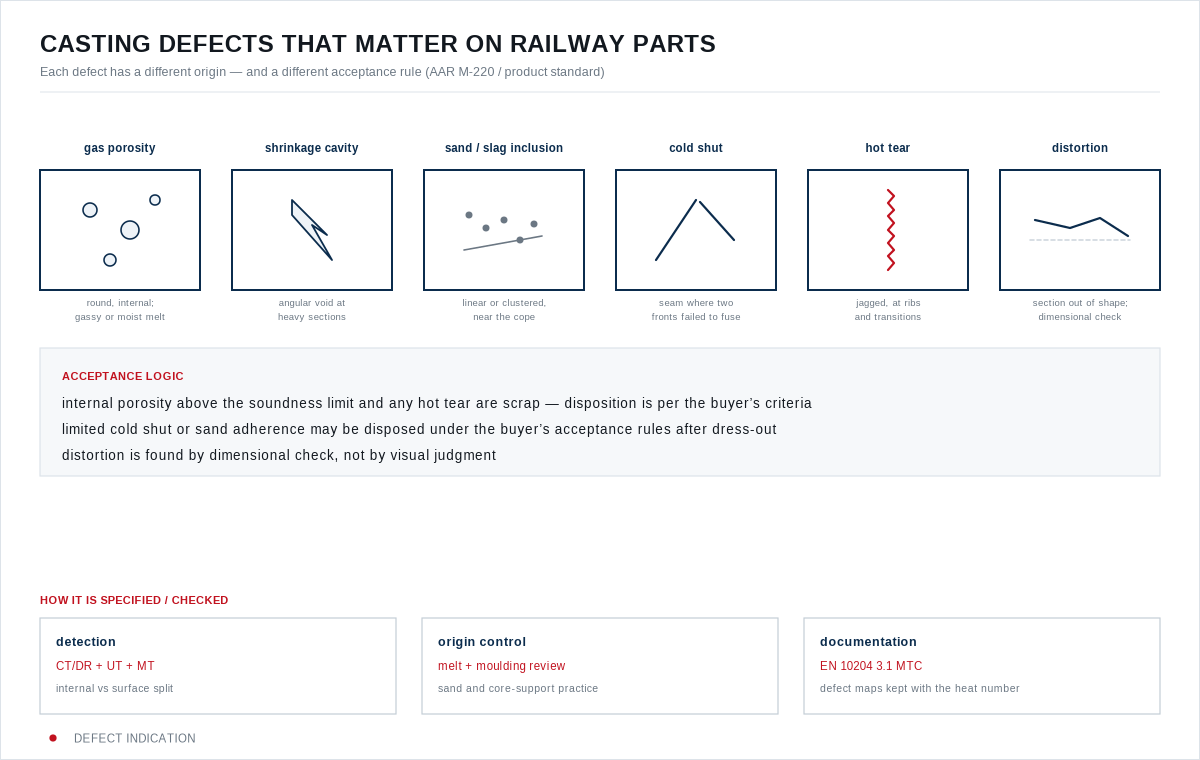
Casting Defect Map: Cause, Location and Detection Method
Railway castings fail their acceptance inspection for a small number of recurring reasons. This table maps each defect to where it forms in the casting, what causes it, and which detection method will find it.
| Failure mode / rejection condition | Consequence or cause | Detection method | Disposition |
|---|---|---|---|
| Gas porosity | Throughout the section, often clustered | Low melt temperature, poor deoxidation, damp sand | 9MeV industrial CT, radiography |
| Shrinkage cavity | Hot spots: rib roots, transitions, blind sections | Insufficient feeding, high contraction alloy | 9MeV industrial CT, UT |
| Sand inclusion | On the upper surface and in blind pockets | Poor mould handling, inadequate core support | Magnetic particle, radiography |
| Sand adherence | On the surface of the casting | Sand bonding strength too high, no collets | Visual and dimensional |
| Cold shut | At the junction of two flows of metal | Low pouring temperature, poor gating design | Magnetic particle, UT |
| Hot tear | At corners and section changes | High restraint during solidification, low ductility | Magnetic particle, visual |
| Misrun | At the far end of the cavity | Insufficient metal, low fluidity, early freeze | Visual, dimensional |
| Distortion | Overall, especially thin walled boxes | Differential contraction, incorrect chill placement | Dimensional against the drawing |
Important. Repair of a rejected railway casting is a buyer's decision, not the foundry's. SIMIS issues the NDT report and the defect location; the disposition is made against the buyer's acceptance criteria.
Why Defects Form in Railway Castings
Most railway defects trace to three process stages: melting, moulding and pouring. Gas porosity and shrinkage both come from the liquid metal stage — porosity from trapped gas or incomplete deoxidation, shrinkage from feed paths that cannot keep up with solidification at thick junctions. Sand inclusions and adherence come from the mould stage, where loose sand or weak core support lets sand enter the cavity. Cold shuts, misruns and hot tears come from pouring and solidification control — temperature, gating and the restraint built into the rigging.
How Production Equipment Reduces Defects
SIMIS reduces these defects at the source. The German HWS V-process vacuum sand casting line uses a bonded-less, rigid mould that holds dimension and keeps loose sand out of the cavity. EBT and LF duplex refining lowers sulphur and oxides so the melt deoxidises cleanly, cutting gas porosity. Controlled pouring temperature and gating design reduce cold shuts and misruns, while chill and feeding practice at rib roots limits shrinkage. After casting, 9MeV industrial CT or DR scans critical bogie parts so internal voids are found before machining.
Acceptance, Inspection and Disposition
Finished castings are inspected by magnetic particle (MT) for surface indications, ultrasonic (UT) and 9MeV CT for internal soundness, and dimensional checks against the drawing. The factory material certificate records the results per heat. When a defect is found, SIMIS issues the NDT report and the exact defect location; whether the part is repaired, reworked or scrapped is the buyer's decision, made against the buyer's own acceptance criteria and the purchase order.
Frequently Asked Questions
How do gas porosity and shrinkage differ?
Gas porosity appears as fine, scattered voids from trapped gas or poor deoxidation, while shrinkage cavities are larger voids at hot spots like rib roots from insufficient feeding. Porosity is found by 9MeV CT or radiography; shrinkage by CT or UT. Both are internal and non-repairable without the buyer's written approval.
Why do sand inclusions appear in castings?
Sand inclusions lodge on upper surfaces and in blind pockets when mould handling is poor or core support is inadequate. They are detected by magnetic particle inspection and radiography, and confirmed by visual checks at the affected surface. The German HWS V-process vacuum line reduces loose sand through rigid, bonded-less moulds and controlled filling.
Which defect types are repairable and which are scrap?
Surface defects such as minor sand adherence or limited cold shut may be disposed per the buyer's acceptance criteria, while any internal porosity above the soundness limit and any hot tear are treated as scrap. Repair of a rejected casting is the buyer's decision; SIMIS issues the NDT report and defect location for disposition.
Related Reading
Request a Quotation
Send your drawing and acceptance criteria to sales@simisrail.com. SIMIS confirms receipt within 1 working day and returns a quotation with indicative lead time and MOQ. NDT scope and the disposition route for any non-conformance are agreed in the quotation, and any non-conformance is a quality matter for the casting plant that produced the casting.
Technical Review
For a question on the common casting defects, contact Felix at sales@simisrail.com or +86-13934165890.