
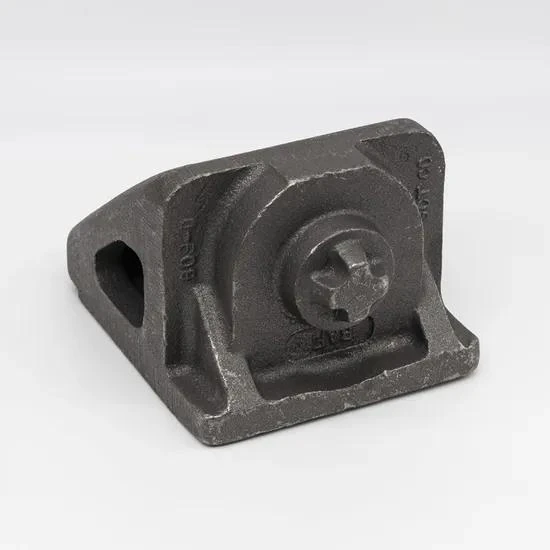
Failure & inspection
Friction Wedge Failure: Why ADI Wedges Crack or Wear Flat
Friction wedges fail by body crack, flat wear, grooving or spalling. Compare ADI Grade 900 and ZGMn13, and learn how to measure wedge wear at inspection.
Published: · Last updated: · Reviewed by Fan Yaoqiang
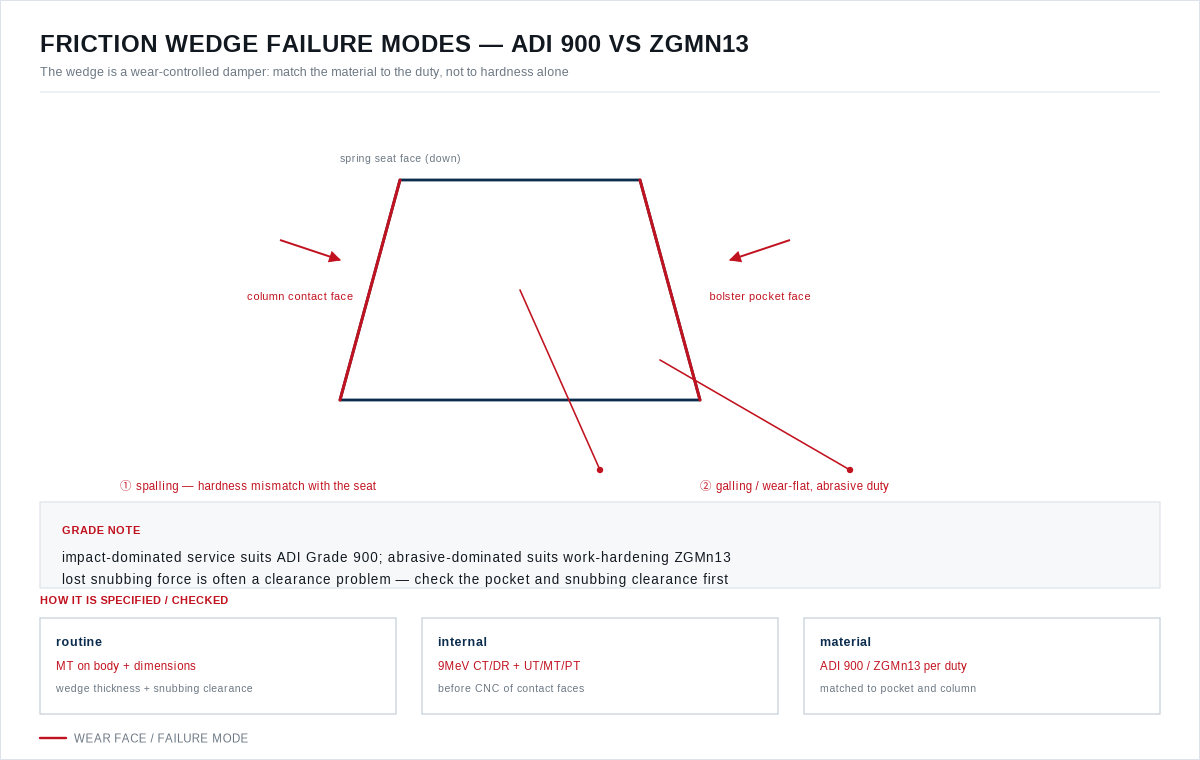
A friction wedge fails in four ways, and choosing ADI Grade 900 or high manganese steel (ZGMn13) depends on which failure you expect. A wedge cracks through the body from impact, wears flat on the friction face from normal contact, grooves from trapped debris, or spalls from a hardness mismatch with the rail seat. SIMIS casts both ADI and ZGMn13 wedges and matches the material to the service mode.
ADI Grade 900 versus ZGMn13: Material Choice
| Property | ADI Grade 900 | ZGMn13 (high manganese steel) |
|---|---|---|
| Hardness behaviour | High as-cast, shock resistant | Work-hardens under impact |
| Resists | Body crack, impact | Flat wear, grooving |
| Failure it resists | Impact from hard stop | Abrasion at the friction face |
| Typical use | General freight snubbing | High-abrasion mining service |
The material decision is not "stronger is better" — it is "match the wear mode". An ADI wedge in a high-abrasion pocket still grooves; a ZGMn13 wedge under repeated shock still cracks.
Technical Mechanism: How a Wedge Snubs
In a three-piece bogie the friction wedge sits in the bolster pocket and presses against the side frame column. As the car rolls and the side frame moves relative to the bolster, the wedge friction converts relative motion into damping — this is the snubbing function. AAR M-201 defines the steel casting grades that such wear parts are produced to, and the wedge pocket geometry is set by the bolster and side frame design. The friction wedge is supplied as a bogie casting, in the same product family as the bolster and the side frame it works with, because the wedge, the pocket and the column form one matched wear set.
Snubbing force depends on wedge travel and the clearance in the pocket, not only on the wedge material. When the wedge wears flat, the snubbing clearance opens and damping drops; when the wedge cracks, the load path breaks. Because the wedge is a wear-and-shock part, its material must suit the dominant load: impact-dominated service favours ADI Grade 900, abrasion-dominated service favours ZGMn13.
Production Equipment and Process Control
Wedges are poured on the German HWS V-process vacuum sand casting line, holding the friction face and the pocket-contact contours to the tolerances the snubbing geometry needs. EBT + LF duplex refining limits inclusions that would seed a body crack at the thin wedge web.
Each wedge is verified by 9MeV industrial CT/DR volumetric scanning and by UT/MT/PT before CNC machining of the contact faces. Normalising and tempering — or the appropriate austempering for ADI — delivers the toughness or work-hardening response the service requires, with furnace records tied to the heat number.
Inspection, Acceptance and Traceability
Every wedge ships with the factory material certificate, fully compliant with EN 10204 3.1, a heat number and an individual serial number. NDT reports are filed against that serial so a depot can trace a cracked or worn wedge back to its melt and inspection record.
Because wear is a paired condition, SIMIS supplies wedges against the specific bolster pocket and side frame column the fleet runs, so the wedge seats correctly and the snubbing clearance is set at installation rather than discovered in service.
Typical Failure Modes and Detection Methods
Friction wedges fail in three distinct ways, and the choice of ADI Grade 900 or high manganese steel depends on which mode is expected. This table maps the failure mode to its cause and to the material that resists it.
| Failure mode / rejection condition | Consequence or cause | Detection method | Disposition |
|---|---|---|---|
| Body crack | Impact from a casting defect or from a hard stop | Magnetic particle | ADI Grade 900, shock absorbing |
| Flat wear on the friction face | Normal service contact | Dimensional measurement of the wedge thickness | ZGMn13 where abrasion is high |
| Grooving | Debris trapped between the wedge and the rail seat | Visual, dimensional | ZGMn13 |
| Spalling | Hardness mismatch with the rail seat | Visual | Material selection against the rail seat hardness |
| Loss of snubbing force | Wedge travel or clearance change, not material wear | Dimensional measurement of the snubbing clearance | Not a material problem |
Important. A wedge that has lost snubbing force is often a clearance problem rather than a worn wedge. Check the wedge pocket and the snubbing clearance before ordering replacement wedges.
FAQ
What causes a wedge to crack through the body?
A body crack is usually seeded by a casting defect or by impact from a hard stop, not by normal wear. Magnetic particle inspection at the wedge body finds the crack; the fix is a shock-absorbing ADI Grade 900 wedge with verified internal soundness rather than a wear-hardened material, because the failure is impact-driven, not abrasion-driven.
Is ADI or high manganese steel better for wedge wear?
Neither is universally better. ADI Grade 900 resists body cracking and impact, while ZGMn13 (high manganese steel) work-hardens and resists flat wear and grooving where abrasion is high. Choose ADI for shock loading and ZGMn13 for high-abrasion contact against the rail seat.
How do you measure wedge wear at inspection?
Measure the wedge thickness and the snubbing clearance dimensionally against the drawing limit. Flat wear shows as reduced wedge thickness on the friction face; loss of snubbing force shows as changed clearance. Below the restore limit the wedge is condemned regardless of its material.
Which mining wagon chassis wear parts are supplied for heavy haul fleets?
For heavy-haul and mining fleets SIMIS supplies friction wedges, lower side bearing wear plates and other suspension-wear castings in ADI or ZGMn13, each with the factory material certificate, fully compliant with EN 10204 3.1 and 100% volumetric scanning, so the wear pair is matched to the rail seat and bolster pocket it runs against.
Related
CTA
Send your wedge drawing, bolster pocket geometry and service mode to sales@simisrail.com. SIMIS confirms receipt within 1 working day and returns a quotation within 3 working days, stating material grade, indicative lead time and MOQ.
Technical Review
Where a grade is a substitute rather than an equivalent, that difference is stated on the page. For a question on ADI Grade 900 against ZGMn13, contact Felix at sales@simisrail.com or +86-13934165890.