
Standards & materials
18-100 vs AAR Three-Piece Freight Bogies Compared
The 18-100 and AAR three-piece bogies share a cast side frame and bolster layout but differ in gauge, axle load and steel grade. Compare dimensions.
Published: · Last updated: · Reviewed by Fan Yaoqiang
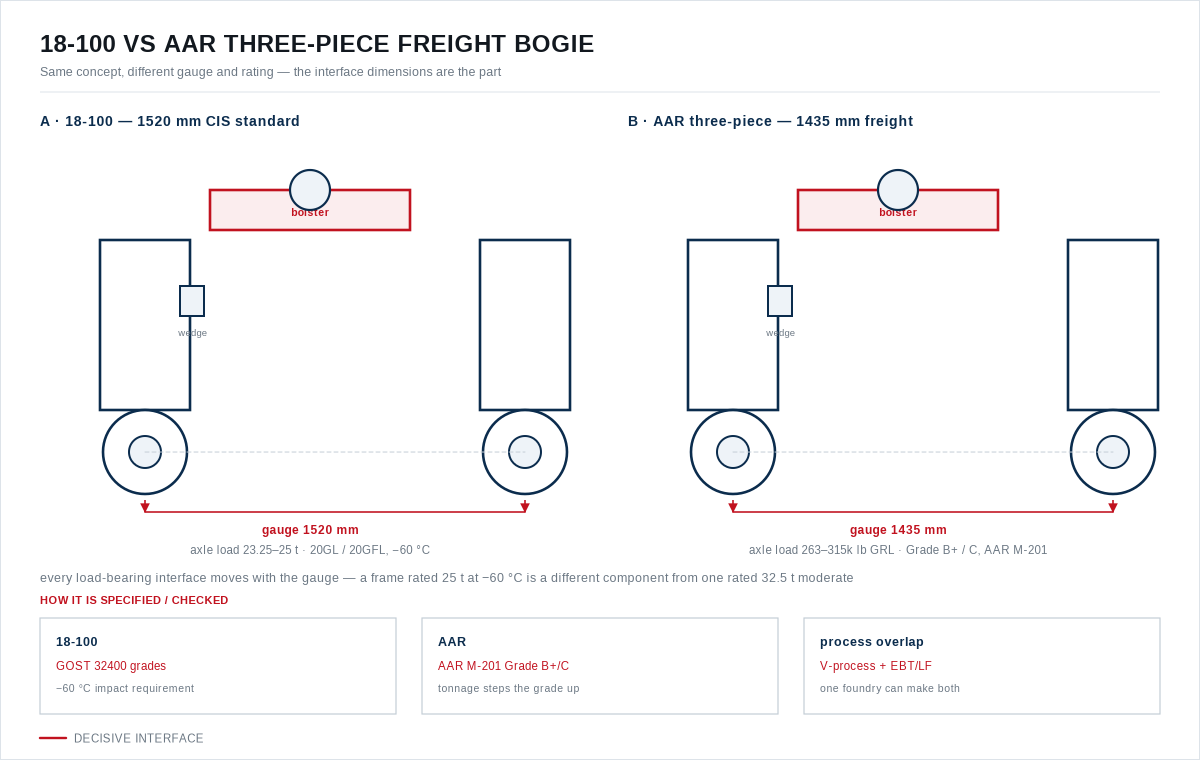
The 18-100 and the AAR three-piece bogie look almost identical on paper: both use two cast steel side frames, one cast steel bolster, wedge friction damping and an axle box at each corner. Yet they serve different rail gauges, axle loads and temperature extremes, so the castings that look alike are not alike. The 18-100 is the workhorse of the 1520 mm CIS network at 23.25–25 t axle load, while the AAR design covers 1435 mm North American freight at 263,000–315,000 lb gross rail load. Choosing between them is a question of gauge and rating, not appearance.
The Shared Three-Piece Concept
Both bogies descend from the same engineering idea: a bolster carries the body load and pivots on a centre plate, two side frames locate the wheelsets, and wedge friction sets absorb vibration. This is why a visitor to a workshop can mistake one for the other. The similarity is real at the system level but ends at the interface dimensions — the very dimensions that a casting must hold to be a conforming spare.
Because both rely on cast side frames and bolsters, the manufacturing processes overlap: V-process or resin sand moulding, EBT/LF refined steel, normalizing and tempering, and UT/MT inspection. A foundry that can make one family can usually make the other; the barrier is the drawing and the standard, not the foundry technique.
Key Dimensions and Gauge
The decisive difference is gauge. The 18-100 runs on 1520 mm track with a wheelbase around 1850 mm and wheel centres spaced for that gauge; the AAR bogie runs on 1435 mm track with its own wheelbase and journal spacing. These gauges change every load-bearing interface — the axle-box window, the bolster centre-plate diameter and the spring seat pitch.
A side frame is therefore not a generic part. The 18-100 frame's axle-box window and wear plates are positioned for 1520 mm geometry, while the AAR frame is positioned for 1435 mm. Swapping one for the other moves the wheelset out of its designed position and breaks the suspension geometry, which is why standards forbid such mixing.
Axle Load and Steel Grade Differences
The 18-100 carries a nominal 23.25 t axle load (up to 25 t in later variants) and is specified for −60 °C service, so its castings use low-temperature grades such as 20GL or micro-alloyed 20GFL. The AAR bogie spans a wider band: 70-ton cars around 30 t axle load use Grade B+ steel per AAR M-201, while 100- and 125-ton cars step up to Grade C for higher strength and toughness.
This grade split is not cosmetic. A side frame sized and alloyed for 25 t at −60 °C is a different component from one sized for 32.5 t at moderate temperatures. The mechanical requirements, section thickness and impact testing all move with the axle load and the climate, so the two families diverge precisely where the standard is strictest.
Interchangeability Limits
Interchange between the two is limited to philosophy, not parts. Within the 1520 mm family, 18-100 side frames and bolsters are designed to be interchangeable with each other under GOST 32400-2013; within the AAR family, M-203/M-202 approved frames and bolsters are interchangeable by AAR rules. Cross-family interchange is not permitted because the gauges and interfaces do not match.
For a fleet operator the practical rule is simple: keep each bogie type on its own track and its own spare pool. A CIS operator running 1520 mm wagons sources 18-100 castings; a North American operator sources AAR-approved castings. Attempting to bridge the two with the "wrong" frame creates a non-conforming, unsafe assembly.
Sourcing the Castings
Both families demand documented conformance: GOST 32400-2013 for the 18-100 side frames and bolsters, and AAR M-201/M-203/M-202 for the AAR parts. SIMIS casts railway bogie castings for both gauge families and supplies freight wagon side frame casting to the 1520 mm specification, with per-heat material certificates, volumetric NDT and full traceability.
Because the drawings differ by type, pattern development is confirmed per enquiry — the 18-100 geometry is distinct from any AAR frame, and each requires its own tooling validation before series production.
FAQ
What are the main dimensions of an 18-100 bogie?
The 18-100 is a 1520 mm gauge three-piece bogie: two cast steel side frames, one cast steel bolster, a wheelbase near 1850 mm and a nominal axle load of 23.25–25 t. Its centre-plate and spring seats are dimensioned to GOST 32400-2013, so any replacement frame must match those interfaces exactly.
Can 18-100 side frames be used on AAR bogies?
No. The 18-100 runs on 1520 mm track with wider wheel spacing and different bolster-to-frame interfaces than the AAR 1435 mm design. The side frames are not dimensionally interchangeable, and mixing them would put the wheelbase and load path out of specification.
Which bogie type suits 100 to 120 tonne axle load?
Neither a standard 18-100 nor a standard AAR 70-ton bogie is built for 100–120 t axle load. That range needs reinforced designs — the AAR 125-ton specification with Grade C castings, or a dedicated heavy-haul 1520 mm variant — not an off-the-shelf 18-100 or AAR frame.
Related
Get a Quotation
Send the bogie model and the axle load with the drawing, drawing number or part number to sales@simisrail.com. SIMIS confirms receipt within 1 working day and returns a formal quotation within 3 working days, with indicative lead time and MOQ confirmed in the quotation. For urgent replacement programmes, contact Felix on WhatsApp at +86-13934165890.
Technical Review
For a question on the 18-100 and AAR three-piece bogies, contact Felix at sales@simisrail.com or +86-13934165890.