
Failure & inspection
9MeV Industrial CT and DR Scanning for Railway Castings
How 9MeV industrial CT and DR detect internal defects in thick-walled railway castings beyond radiography, and where volumetric inspection applies.
Published: · Last updated: · Reviewed by Wang Yan
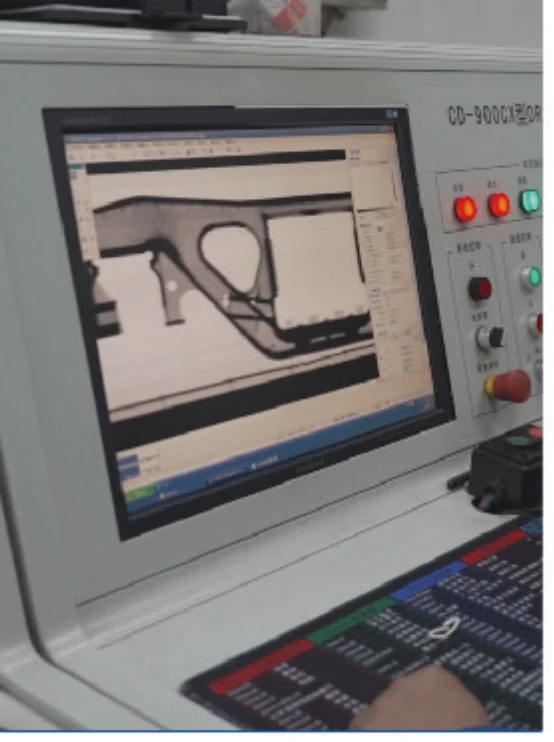
Internal defects in thick-walled railway castings are detected reliably with 9MeV industrial CT and DR, high-energy volumetric scanning that penetrates steel up to 300–400 mm where conventional 150–450 kV radiography under-penetrates. CT builds a 3D map of the entire internal volume, finding micro-shrinkage, blowholes, and cracks that film radiography can miss. SIMIS applies 9MeV CT as 100% volumetric inspection on critical thick sections, plus UT and MT on specified surfaces.
NDT Methods for Railway Castings at a Glance
| Method | Penetration | What it sees | Limitation |
|---|---|---|---|
| UT (ultrasonic) | Deep | Internal discontinuities, thickness | Needs skilled interpretation |
| MT (magnetic particle) | Surface / near-surface | Surface cracks | Ferromagnetic only |
| Radiographic (150–450 kV) | Thin to medium | 2D density variation | Under-penetrates thick steel |
| 9MeV CT / DR | 300–400 mm steel | 3D internal volume | High-energy equipment |
The table shows why thick railway castings need a high-energy step: the methods that see surfaces well cannot see deep enough into a heavy section.
Why Low-Energy NDT Under-Penetrates Thick Castings
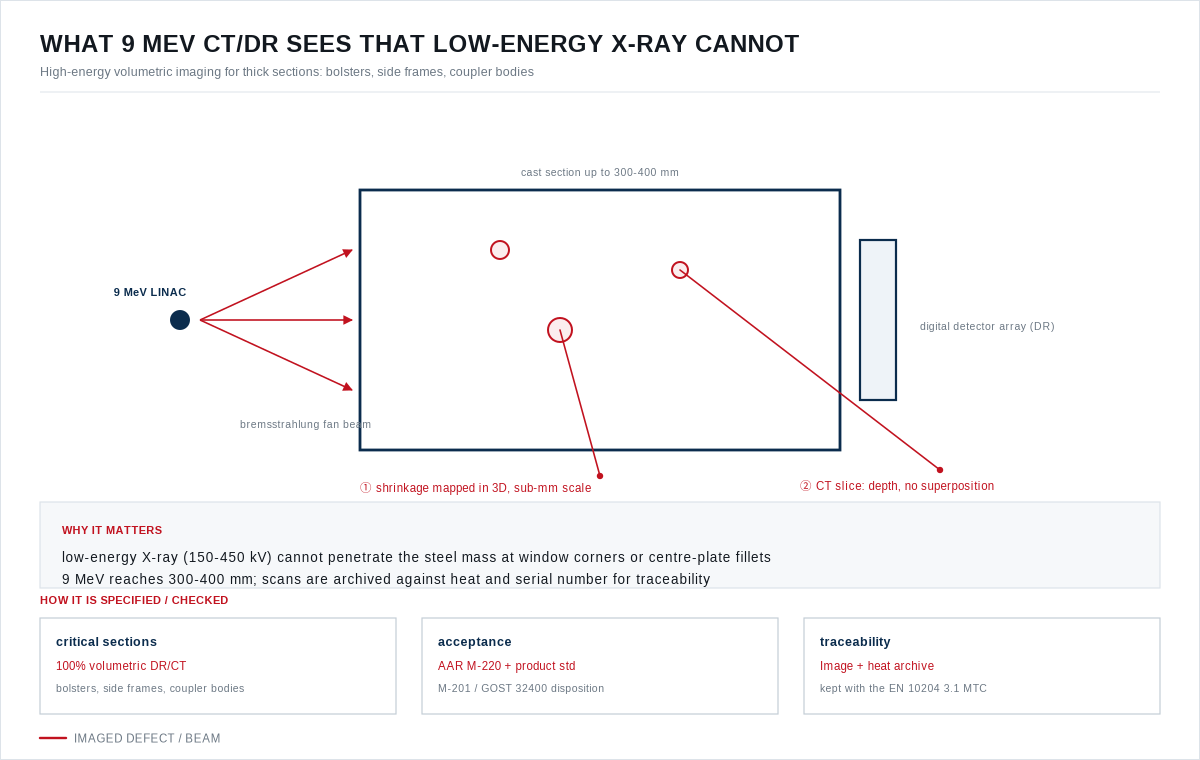
Heavy railway castings are defined by severe section-thickness transitions. A side-frame pedestal jaw or a bolster centre-plate rim is a concentrated mass of steel. When a conventional 150–450 kV X-ray system tries to audit these zones, the low-energy photons are heavily absorbed or scattered, producing poor contrast and image degradation.
The dangerous consequence is hidden failure initiation. Sub-surface micro-shrinkage, internal blowholes, and micro-fissures remain masked inside the core. Under dynamic track loads these hidden defects act as notch indicators, initiating premature fatigue cracking or brittle failure that no surface inspection would have caught.
What 9MeV CT and DR Detect
A high-resolution industrial 9MeV linear accelerator redefines non-destructive assurance for heavy sections. Operating at 9 MeV, the bremsstrahlung radiation penetrates steel up to 300–400 mm, yielding high-contrast digital radiography (DR) arrays and full 3D computed tomography (CT) reconstructions of the entire internal volume.
The CT system maps the structure layer by layer, resolving internal voids, porosity clusters, and micro-cracks down to sub-millimeter scale. Any casting whose interior voids exceed the acceptance limit set by the relevant standard — AAR M-220 for NDT, or AAR M-201 / GOST 32400 for the product — is flagged and rejected. The scan is archived and linked to the casting's serial number for traceability.
Production Equipment: the 9MeV Linear Accelerator
SIMIS operates a 9MeV high-energy DR and CT imaging system as part of its quality line. The accelerator and detector are positioned to scan the thick, mass-concentrated zones of bolsters, side frames, and coupler bodies — the intersections where shrinkage and porosity are most likely to hide.
Because the system produces a digital volume rather than a film, every scan is stored electronically and tied to the heat number and serial number. This gives buyers and auditors a verifiable internal-soundness record for each casting, not just a pass/fail stamp.
Acceptance and Traceability
Volumetric scanning is one layer of a full acceptance package. Every casting ships with the factory material certificate, fully compliant with EN 10204 3.1 and a single-piece serial number linking it to its melt. The 9MeV CT/DR result is archived, and UT plus MT verify specified surfaces. Acceptance follows AAR M-220 and the applicable product standard, subject to the buyer's third-party inspection and MTC review — internal soundness verified by 100% volumetric scanning where the section demands it.
FAQ
What can 9MeV industrial CT detect that radiography cannot?
Conventional radiography (150–450 kV) under-penetrates thick alloy steel, so sub-surface micro-shrinkage, clustered porosity, and micro-fissures stay hidden. A 9MeV linear accelerator penetrates up to 300–400 mm and reconstructs a 3D CT volume, resolving internal voids and cracks down to sub-millimeter scale that 2D film radiography cannot separate from overlay noise.
Do railway castings need 100% volumetric inspection?
Not every casting requires 100% volumetric inspection; the decision follows the part's criticality and section thickness. For heavy safety-critical parts such as bolsters, side frames, and coupler bodies, SIMIS applies 100% volumetric scanning on thick intersections because a hidden void there is a fatigue initiator. Lighter or lower-stress parts may use spot UT/MT per the acceptance standard.
Is CT inspection required by AAR?
AAR does not mandate 9MeV CT by name; AAR M-220 and M-201 set the nondestructive testing and acceptance requirements that a foundry meets by the method it chooses. Many builders adopt high-energy volumetric scanning as their internal route to satisfy those requirements on thick sections, because it finds defects that surface-only methods miss. Confirm the agreed method in the purchase specification.
Related
Contact SIMIS
SIMIS Precision Casting Co., Ltd. verifies safety-critical railway castings with a 9MeV industrial CT/DR system supported by UT and MT. Send the section thickness and the defect you need to resolve with the drawing, drawing number or part number to sales@simisrail.com. or reach Felix on WhatsApp / mobile +86-13934165890; we confirm receipt within 1 working day and return an indicative quotation for your review.
Technical Review
For a question on 9MeV CT and DR detection, contact Felix at sales@simisrail.com or +86-13934165890.