
Quality & inspection
UT, MT, PT or Radiography: Which NDT for Which Casting?
Ultrasonic, magnetic particle, penetrant and radiographic testing each suit different rail casting flaws. Learn which method fits thick sections, surfaces.
Published: · Last updated: · Reviewed by Wang Yan
Choosing a nondestructive test for a railway casting is not a menu where any method works — each technique sees a different kind of flaw, and the wrong choice leaves a defect undetected. Ultrasonic (UT), magnetic particle (MT), liquid penetrant (PT) and radiography each have a clearly defined role in quality and certification. Knowing which to specify for a side frame, a coupler or a thin bracket is what keeps a casting both safe and cost-effective.
The Four Methods and What They See
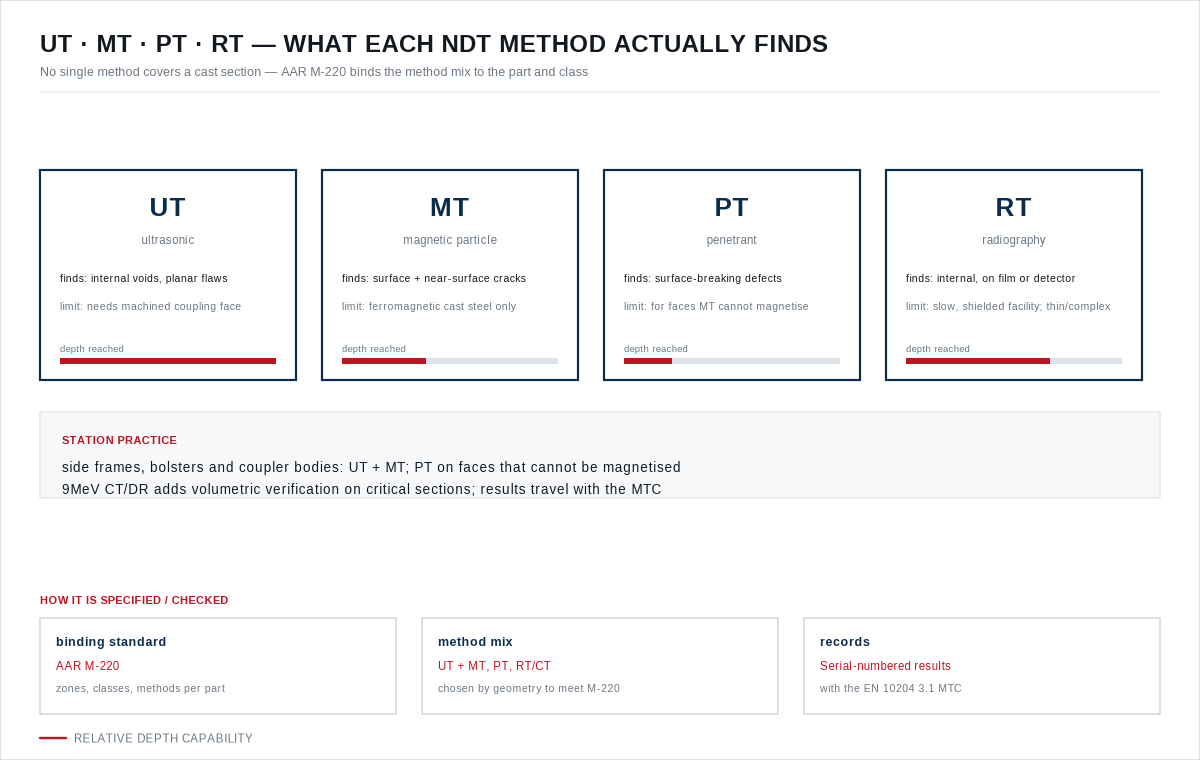
UT sends sound waves through the section and echoes discontinuities back, so it sees *internal* volumetric flaws — shrink, porosity, inclusions — in thick steel. MT magnetises the part and reveals *surface and near-surface* cracks through powder indication. PT dyes a surface and shows *surface-breaking* flaws on any non-porous material. Radiography passes radiation through the part to image internal defects on film or detector.
The immediate rule is geometry and depth: deep volume → UT or radiography; surface/near-surface → MT (ferromagnetic) or PT (any). No single method covers both, so real inspection plans combine them.
Matching Method to Casting and Defect
A heavy side frame or bolster is a thick-section part where internal soundness decides service life. UT is the practical volume tool here, backed by MT on the high-stress surfaces — axle-box windows, spring seats, centre-plate — to catch fatigue-initiating cracks. A coupler body, being safety-critical and complex, is typically controlled by UT plus MT on specified zones, with PT as a supplement where geometry blocks magnetism.
Thin, intricate castings — small brackets, some coupler small parts — may be hard for UT beams to interpret, so radiography or MT/PT takes the lead. The method follows the part's wall thickness and shape, not a one-size rule.
Where Radiography Still Applies
Radiography has lost ground to UT and to volumetric CT because it is slower and needs shielded facilities, but it still earns its place. It is the method of choice for tight geometric features and thin, complex sections where UT beam paths are ambiguous, and for certain coupler and draft-gear details where a planar image clarifies a suspect zone.
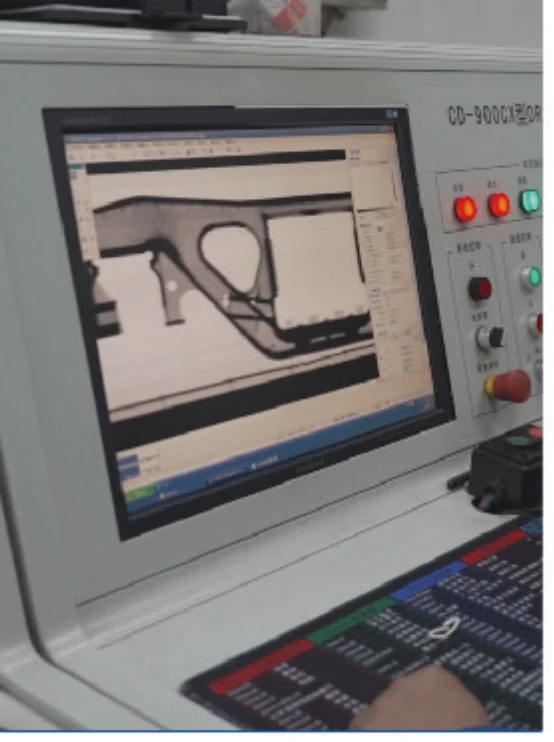
SIMIS complements radiography with 9MeV industrial CT inspection, which produces a full volumetric record of critical sections without the film-and-lead logistics of traditional radiography. For many thick railway castings, CT/DR now covers the internal-soundness role radiography once held exclusively.
AAR M-220 and the Method Choice
AAR M-220 (Casting Component Nondestructive Testing Requirements) is the reference that ties method to part. It sets *what* must be inspected — the zones, the acceptance levels and the applicable methods for each class of casting — rather than leaving the choice to chance. A foundry working to AAR requirements reads M-220 to know which surfaces get MT, which volumes get UT, and which details need radiography.
So M-220 prescribes the *requirements*; the foundry selects UT, MT, PT or radiography to satisfy them according to geometry. The standard removes ambiguity about coverage, which is exactly why it appears in North American casting specifications and in the standards comparison buyers review.
SIMIS NDT Practice
SIMIS applies the combination by part: UT and MT on side frames, bolsters and coupler bodies, PT where a surface cannot be magnetised, and 9MeV CT/DR volumetric scanning for internal verification of critical sections. Every examination is recorded against the heat number and serial, and the results travel with the factory material certificate, fully compliant with EN 10204 3.1.
For buyers, the practical step is to name the acceptance standard — AAR M-220 for North American work, the relevant GOST or EN requirement elsewhere — and SIMIS returns the matching NDT plan and reports. Indicative lead time and MOQ are confirmed in the quotation, and the NDT evidence is assembled for the certification file.
When a buyer compares a railway casting NDT supplier, the test is the evidence rather than the method list: for each drawing SIMIS Precision Casting Co., Ltd. states the method per zone, records every examination against the heat number and individual serial, and issues the matching NDT report with the factory material certificate, fully compliant with EN 10204 3.1.
FAQ
Which parts get radiography rather than UT?
Radiography is reserved for zones where ultrasonic beams cannot reach or where thin, complex sections make UT unreliable — typically tight geometric features and certain coupler or draft-gear details. Thick, open sections such as side frames and bolsters are usually controlled by UT plus MT instead, because UT covers the volume more practically.
Is magnetic particle testing suitable for all rail castings?
MT detects surface and near-surface flaws on ferromagnetic steel, so it suits the vast majority of carbon and low-alloy railway castings. It cannot be used on non-ferromagnetic materials, where penetrant testing (PT) is the surface method of choice, and it sees nothing of internal volumetric flaws that UT or radiography must catch.
Does AAR M-220 prescribe the NDT method?
AAR M-220 (Casting Component Nondestructive Testing Requirements) sets the NDT requirements for casting components — the areas to inspect, the acceptance levels and the methods applicable to each class of part. It prescribes the requirements; the foundry then applies UT, MT, PT or radiography to meet them per the component's geometry.
Related
Get a Quotation
Send the NDT method required by your acceptance document with the drawing, drawing number or part number to sales@simisrail.com. SIMIS confirms receipt within 1 working day and returns a formal quotation within 3 working days, with indicative lead time and MOQ confirmed in the quotation. For urgent replacement programmes, contact Felix on WhatsApp at +86-13934165890.
Technical Review
For a question on the UT, MT, PT and radiography methods, contact Felix at sales@simisrail.com or +86-13934165890.