
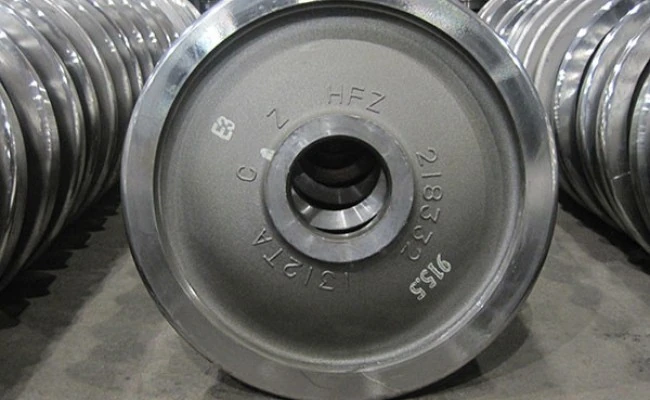
Process & products
Graphite vs Sand vs Forged: Choosing a Railway Wheel
Railway wheels come as graphite-mould cast, sand cast or forged. Compare cost, fatigue and heavy-haul suitability to choose the right wheel for your fleet.
Published: · Last updated: · Reviewed by Wang Min
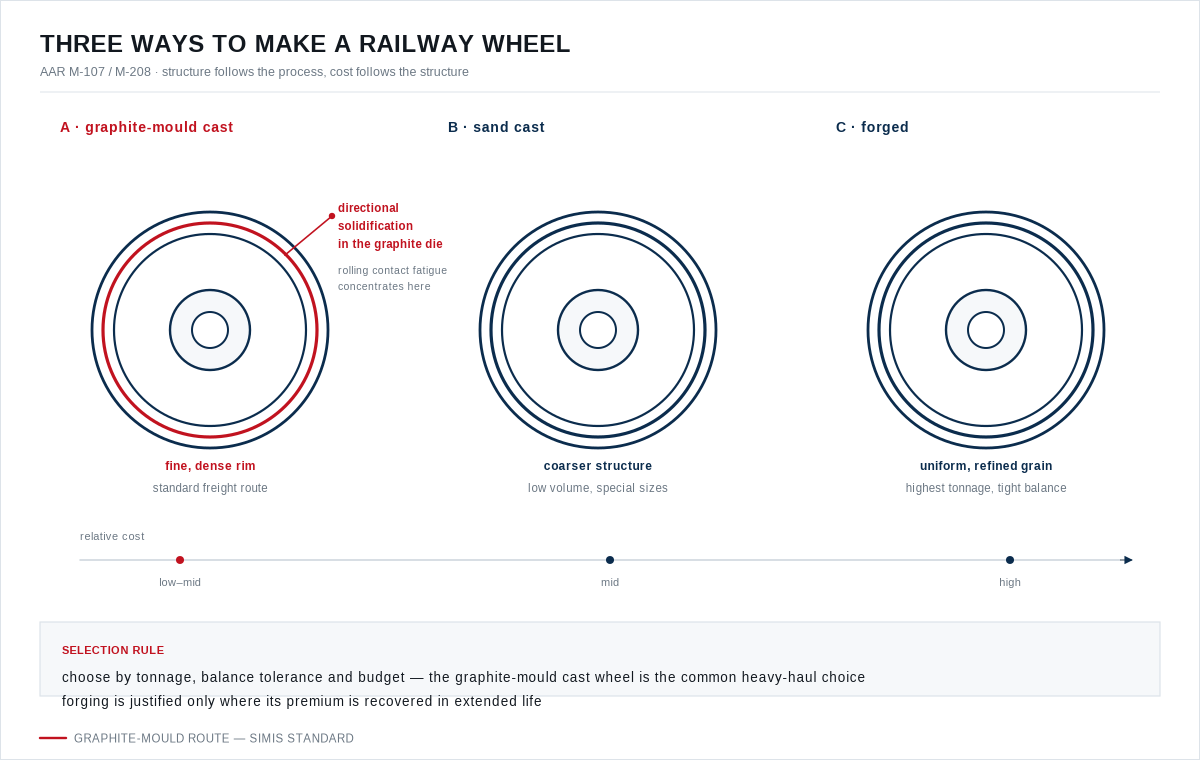
Railway wheels are produced three ways: graphite-mould sand cast, conventional sand cast, and forged. Graphite-mould casting to AAR M-107 / M-208 gives a fine, dense structure at lower cost than forging and is the standard route for most freight wheels; forging suits the highest tonnage and tightest balance needs. Sand casting without a graphite die is used for low-volume or special sizes. Choose by tonnage, balance tolerance and budget.
Three Ways to Make a Railway Wheel
| Method | Structure | Relative cost | Typical use |
|---|---|---|---|
| Graphite-mould cast | Fine, dense | Low–mid | Standard freight wheels (AAR M-107/M-208) |
| Sand cast | Coarser | Mid | Low-volume, special sizes |
| Forged | Uniform, refined | High | Highest tonnage, tight balance |
The graphite die sets the solidification path of the rim, which is where wheel-rail contact loads concentrate. A controlled pour into the die gives a dense, directionally solidified rim that resists rolling contact fatigue.
Fatigue, Cost and Heavy-Haul Suitability
Cast wheels made in a graphite die solidify directionally, giving a dense rim with predictable fatigue behaviour under repeated wheel-rail contact. Forging refines the grain further and is preferred where the wheel sees the highest annual tonnage or the tightest dynamic balance, but at a clear cost premium. Sand casting without the graphite die is flexible for small batches but less consistent in rim density. For a heavy-haul mining fleet the graphite-mould cast wheel is the common choice; forging is justified only where its premium is recovered in extended life.
Production Equipment and Process Control
SIMIS produces cast steel wheels on a controlled pouring line with graphite dies that set the solidification path, then heat treats and machines them to the AAR M-107 / M-208 envelope. Chemical and hardness controls, plus balance checking, confirm the wheel meets the specified rim hardness and soundness. Forged wheels, where specified, are sourced through controlled supply and verified to the same acceptance criteria.
Acceptance, Inspection and Traceability
Every wheel is hardness tested at the rim and tread, ultrasonic inspected for internal soundness, and marked with a heat and serial identity. The MTC records chemistry, hardness and NDT results per heat. SIMIS keeps the records for the contract period so a wheel can be traced from the field back to its pour.
Frequently Asked Questions
What are the fatigue life differences between cast and forged wheels?
Forged wheels have the most refined grain and the highest fatigue reserve, but graphite-mould cast wheels to AAR M-107 / M-208 already deliver the fatigue life expected in normal freight service. The practical gap appears only at the highest annual tonnages, where forging's premium is recovered by extended life; for most fleets the cast wheel meets the duty at lower cost.
How does wheel cost compare over a full wheel life?
A graphite-mould cast wheel costs substantially less than a forged wheel at purchase and, in standard freight duty, runs a comparable service interval, giving the lower life-cycle cost for most operators. Forging only pays back where its longer life offsets the higher price under very high tonnage. The economic choice depends on your annual tonnage and renewal policy.
Which wheel type suits heavy haul mining service?
Heavy-haul mining favours the graphite-mould cast wheel for its dense rim and low cost at volume, with forging reserved for the severest tonnage and balance-critical axles. The choice is set by annual tonnes per wheel, track geometry and the operator's renewal strategy. SIMIS confirms the route and acceptance criteria in the quotation against AAR M-107 / M-208.
Related Reading
Request a Quotation
Send your wheel specification, diameter and annual tonnage to sales@simisrail.com. SIMIS confirms receipt within 1 working day and returns a quotation with indicative lead time and MOQ, stating the casting route and AAR M-107 / M-208 acceptance scope.
Technical Review
For a question on the cast and forged wheel routes, contact Felix at sales@simisrail.com or +86-13934165890.