
Quality & inspection
Constant Contact vs Clearance Side Bearings Compared
Constant contact side bearings keep load on the truck at all times for stability; clearance types allow free roll. Compare the fit and inspection.
Published: · Last updated: · Reviewed by Fan Yaoqiang
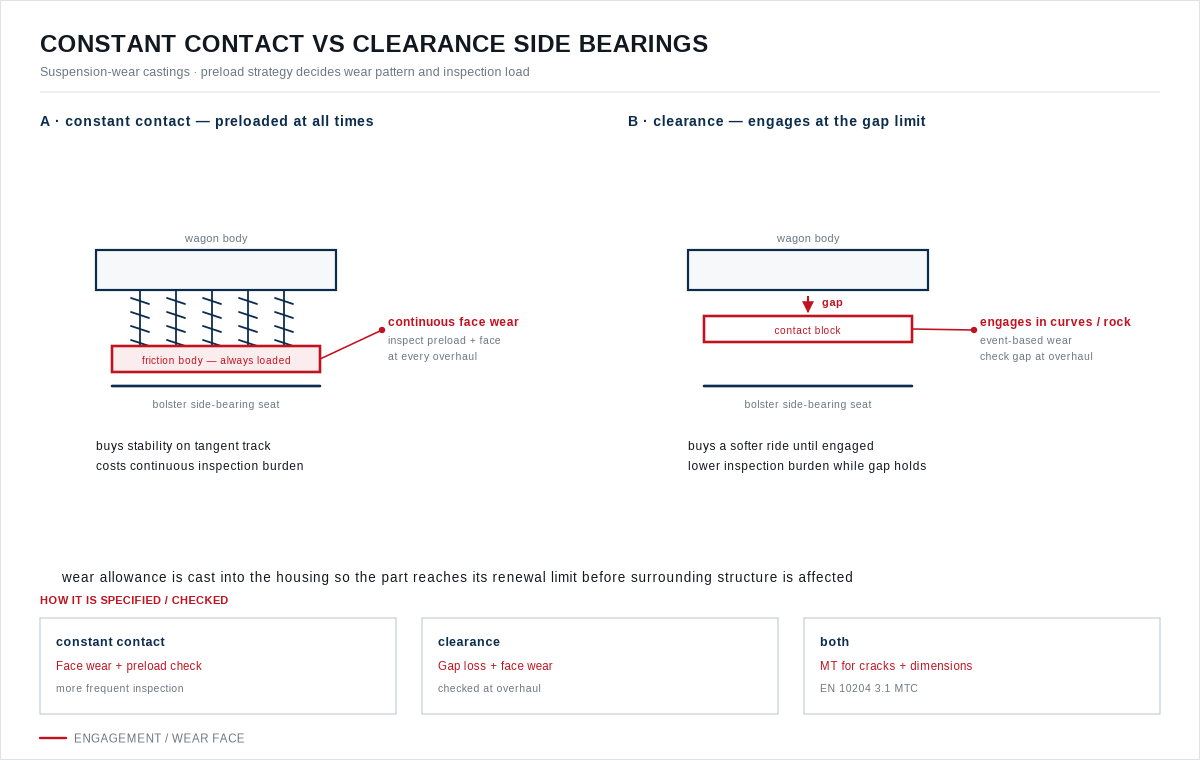
Constant contact side bearings keep a preloaded force on the truck at all times to improve high-speed stability, while clearance side bearings allow the body to roll freely until it meets a gap limit, then engage. The constant-contact type needs more frequent inspection because it is always loaded; the clearance type engages only in curving and overturning. SIMIS casts both to the suspension-wear drawing with a wear allowance built into the housing.
Constant Contact versus Clearance Side Bearings
| Feature | Constant contact | Clearance |
|---|---|---|
| Preload | Always loaded | Engages at gap limit |
| Stability | Higher | Lower until engaged |
| Inspection | More frequent | Less frequent |
| Wear pattern | Continuous | Event-based |
The choice is a suspension trade-off: constant contact buys stability on tangent track, clearance buys a softer ride and a lower inspection burden until the truck meets a curve or rock condition.
How Fit Changes Ride Quality and Wear
A constant contact side bearing applies a set preload through a spring or elastomer, resisting truck hunting and improving ride quality on tangent track, but it is loaded in every mile so its friction faces wear continuously. A clearance side bearing sits with a gap and only takes load in sharp curves or rock, so it wears in events rather than continuously. The choice trades stability against inspection burden and wear rate.
Production Equipment and Wear Allowance
SIMIS casts side bearings on the V-process line and machines the friction and contact faces after heat treatment, building a wear allowance into the housing so the part reaches its renewal limit before the surrounding structure is affected. The contact height and gap are held to the suspension drawing so the as-cast allowance matches the specified service life.
Inspection, Acceptance and Renewal
Constant contact units are inspected more often for friction-face wear and preload loss; clearance units are checked for gap loss and face wear at overhaul. Both are MT-inspected for cracking and dimensionally verified. They are supplied with heat and serial marks and the factory material certificate, fully compliant with EN 10204 3.1, and the wear allowance cast into the housing sets the renewal point.
Frequently Asked Questions
How does side bearing fit change ride quality?
A constant contact side bearing keeps a preload on the truck at all times, damping hunting and improving ride quality on tangent track, at the cost of continuous friction-face wear. A clearance side bearing lets the body roll freely until it meets the gap limit, giving a softer ride but less constant stability. The fit is specified on the suspension drawing to match the car's speed and track profile.
Which type needs more frequent inspection?
The constant contact type needs more frequent inspection because it is loaded in every mile of service, so its friction faces and preload are checked at shorter intervals. The clearance type engages only in curves and rock, so its wear accrues in events and is inspected at the normal overhaul cycle. SIMIS marks each casting for traceable inspection history.
What wear allowance should be cast into the housing?
Cast a wear allowance into the side bearing housing equal to the renewal loss set on the suspension drawing, so the friction face reaches its limit before the surrounding structure is affected. SIMIS machines the contact faces after heat treatment to hold that allowance and supplies the as-cast and finished reference dimensions on the factory material certificate, fully compliant with EN 10204 3.1 for verification.
Related Reading
Request a Quotation
Send your side bearing drawing and the specified fit (constant contact or clearance) to sales@simisrail.com. SIMIS confirms receipt within 1 working day and returns a quotation with indicative lead time and MOQ for side bearings cast on the V-process line.
Technical Review
For a question on constant contact and clearance side bearings, contact Felix at sales@simisrail.com or +86-13934165890.