
Process & products
Graphite Mold Casting for AAR M-107 & M-208 Wheels
Why railway wheels use graphite mould sand casting under AAR M-107/M-208. Sequential solidification, residual stress, and rim hardness explained.
Published: · Last updated: · Reviewed by Wang Min
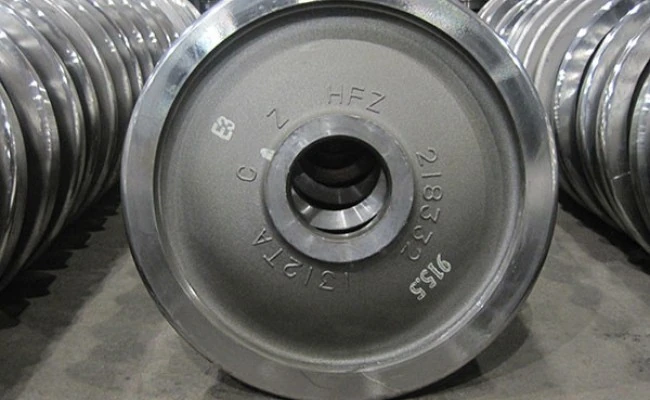
Railway wheels are cast in graphite mould sand because graphite's high thermal conductivity pulls heat directionally from the rim, forcing sequential solidification that prevents micro-shrinkage and residual stress in the tread. Under AAR M-107 and M-208, cast steel wheels need deep rim hardness and a sound microstructure; graphite moulding delivers a dense, fine-grained rim that ordinary sand casting cannot match. SIMIS pairs the mould with EBT+LF refined steel and controlled heat treatment.
Graphite Mould vs Ordinary Sand at a Glance
| Aspect | Graphite mould sand | Ordinary sand |
|---|---|---|
| Thermal conductivity at rim | High (graphite liner) | Low |
| Solidification | Directional, sequential | Slow, random |
| Near-tread porosity | Minimal | Possible |
| Grain structure | Dense, fine | Coarser |
| Rim hardness penetration | Deep, uniform | Less uniform |
The table shows the single physical reason wheels favor graphite: control of the cooling gradient at the most stressed part of the wheel.
How Graphite Mould Delivers Sequential Solidification
AAR M-107 and M-208 define the carbon-steel wheel requirements, including the deep rim hardness penetration and microstructure that resist spalling and shelling under tread-brake thermal cycles. Meeting those requirements starts with solidification control.
A cast steel wheel must survive continuous wheel–rail friction without accelerating tread wear or developing deep shelling cracks. Traditional full-sand molding is a cooling limitation: sand conducts heat poorly, so the molten steel cools slowly and randomly. That slow dissipation yields coarse grain boundaries, micro-segregation, and internal micro-porosity near the tread — exactly where the wheel fails first.
Graphite mould sand reverses this. By positioning high-conductivity graphite blocks at the rim and tread interfaces, thermal energy is extracted rapidly and directionally from the outside in. The controlled gradient forces the steel to solidify sequentially, eliminating micro-shrinkage and residual casting stress at the source.
Graphite Mould vs Ordinary Sand Casting
The practical difference is the cooling path. Ordinary sand casting leaves the tread cooling last and unevenly, so coarse grains and near-surface porosity form where the wheel takes the most load. Graphite mould casting places the conductive liner exactly at the rim, so heat leaves fast and uniformly.
The outcome is a uniform pearlitic matrix with deep hardness penetration instead of a variable one. For a heavy-haul wheel that sees repeated braking heat, that uniformity is what keeps the tread from shelling and extends service life between re-profiling.
Production Equipment: Mould, Refining and Heat Treatment
SIMIS backed the graphite mould wheel line with one of the largest single equipment investments on its rail casting line. The line uses a graphite hanging-sand liner as the primary mould form, with graphite at the rim and tread to drive directional solidification.
The carbon steel is primary-smelted in EBT electric arc furnaces and secondary-refined in LF ladle furnaces, minimizing non-metallic inclusions and dissolved gas. After casting, wheels pass through an automated, fully electric heat-treatment line; micro-controlled electric heating holds the cycle within a tight tolerance so the rim transforms into a uniform, deep-hardening pearlite matrix aligned with the AAR wear thresholds.
Acceptance and Traceability
Every wheel ships with the factory material certificate, fully compliant with EN 10204 3.1 recording the heat number, chemistry, and mechanical results, and a single-piece serial number links it to its melt for lifecycle tracing. Internal soundness is verified by 9MeV CT on thick sections, with UT and MT on specified surfaces. Acceptance follows AAR M-107 and M-208, subject to the buyer's third-party inspection and MTC review.
FAQ
Why is graphite mould casting used for railway wheels?
Graphite mould casting is used because graphite conducts heat far better than sand, so the rim cools fast and directionally from the outside in. That forces sequential solidification, eliminating micro-shrinkage and residual stress in the tread and giving the dense, fine-grained rim structure that AAR M-107 and M-208 wheels require for spalling resistance.
What is the difference between graphite mould and ordinary sand casting?
Ordinary sand has low thermal conductivity, so a wheel cools slowly and randomly, producing coarse grains, micro-segregation, and near-tread porosity that shortens life. Graphite mould sand places high-conductivity graphite at the rim and tread, extracting heat directionally to control the cooling gradient and produce a uniform pearlitic matrix with deep hardness penetration.
How does residual stress affect wheel service life?
Residual stress from uneven cooling seeds shelling, tread cracks, and out-of-round wear, cutting wheel life and raising maintenance. Graphite mould sequential solidification minimizes that stress at the source, and controlled electric heat treatment then relieves what remains, so the wheel keeps uniform grain density and longer tread life under heavy-haul duty.
Related
Contact SIMIS
SIMIS Precision Casting Co., Ltd. produces AAR M-107 / M-208 cast steel wheels by graphite mould sand casting with EBT+LF refining and controlled heat treatment. Send the wheel specification, diameter and annual tonnage to sales@simisrail.com. or reach Felix on WhatsApp / mobile +86-13934165890; we confirm receipt within 1 working day and return an indicative quotation for your review.
Technical Review
For a question on the graphite mould casting route, contact Felix at sales@simisrail.com or +86-13934165890.
Keep reading