
Process & products
K2, K6, DZ1 and 18-100 Bogies: Russian and CIS Bogie Types Explained
K2, K6, DZ1 and 18-100 are the main three-piece bogies of China and the CIS. Compare axle load, gauge and which cast side frames and bolsters each uses.
Published: · Last updated: · Reviewed by Fan Yaoqiang
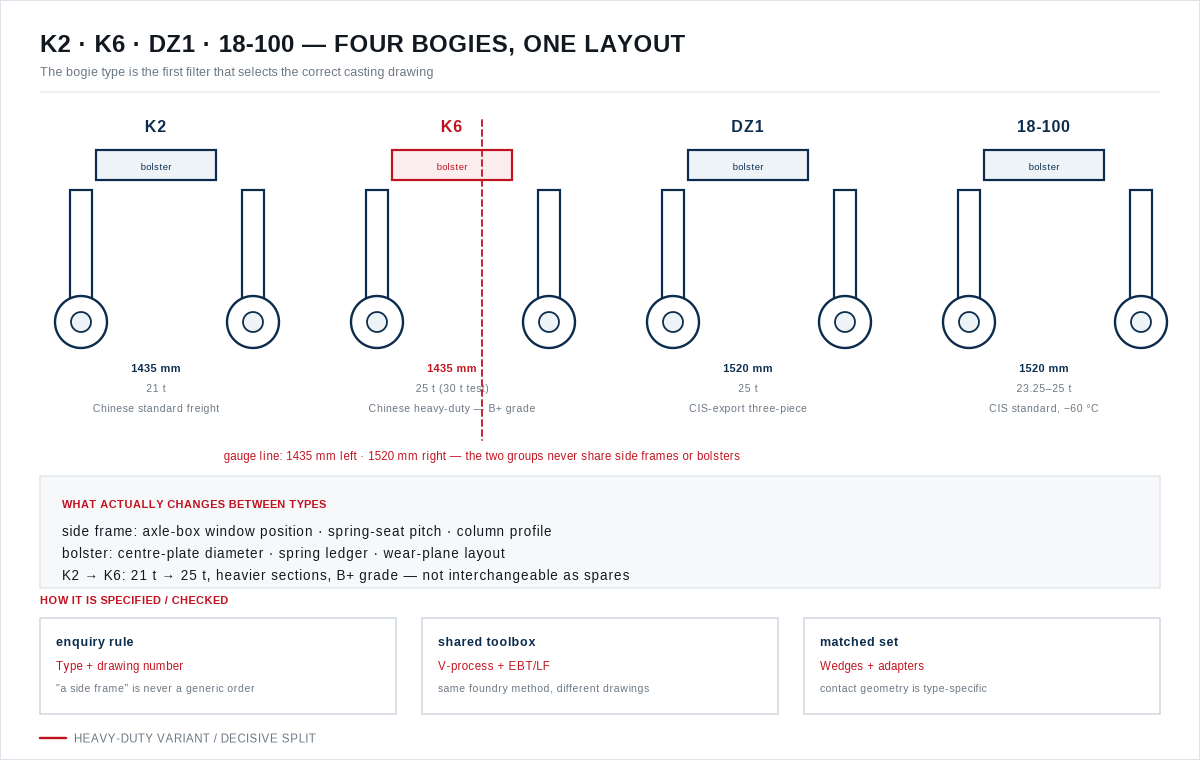
K2, K6, DZ1 and 18-100 are the four three-piece bogies that dominate Chinese and CIS freight. They all share the same skeleton — two cast steel side frames, one cast steel bolster, friction wedges and axle boxes — but they split by gauge and axle load, and those splits decide which casting drawing applies. For a buyer sourcing railway bogie castings, naming the bogie type is the first filter that selects the correct part.
Four Bogies, One Layout
All four are classic three-piece designs, which is why their castings look related on a workshop floor. The 18-100 is the long-serving CIS standard on 1520 mm track; the K2 and K6 are Chinese 1435 mm designs; the DZ1 is China's 1520 mm answer for CIS export. Same philosophy, different nameplates — and the nameplate is what determines interchange.
Because the layout is shared, a foundry's process toolbox carries across all four: V-process or resin sand moulding, EBT/LF refined steel, normalizing and tempering, and UT/MT inspection. The difference is the drawing, the gauge and the rated load, not the foundry method.
Axle Load and Gauge by Type
| Bogie | Gauge | Axle load | Role |
|---|---|---|---|
| K2 | 1435 mm | 21 t | Standard Chinese freight |
| K6 | 1435 mm | 25 t (30 t test) | Heavy-duty Chinese freight |
| DZ1 | 1520 mm | 25 t | CIS-export three-piece |
| 18-100 | 1520 mm | 23.25–25 t | CIS standard |
The gauge split is the hard line: K2 and K6 stay on 1435 mm, while DZ1 and 18-100run on 1520 mm. A 1435 mm frame cannot serve a 1520 mm wheelset, so the two gauge groups never share side frames or bolsters.
Castings That Differ Between Types
Every one of these bogies is built from a cast steel side frame and a cast steel bolster, and each type uses its own drawing. The side frame varies in axle-box window position, spring-seat pitch and column profile; the bolster varies in centre-plate diameter, spring ledger and the wear-plane layout. None of these drawings is a drop-in substitute for another.
Smaller shared parts — friction wedges, adapters, side bearings — are also type-specific in their contact geometry, so a complete bogie rebuild must source the full matched set. The takeaway for a buyer is that "a side frame" is never a generic order; the bogie type and its drawing number must lead the enquiry.
K2 vs K6: What Actually Changes
K2 and K6 are both 1435 mm Chinese bogies, but the K6 is the heavy-duty evolution: 25 t axle load against K2's 21 t. That 4 t difference is carried by heavier-section side frames and bolsters with more rib and wall thickness at the load paths, and by the Chinese B+ low-alloy cast steel grade rather than the lighter grade used on K2.
Practically, a K2 side frame will not meet a K6 service rating, and the two are not interchangeable as spares. A fleet running mixed K2/K6 stock needs separate spare pools sized to each rating, and the casting enquiry must state the exact type to avoid a non-conforming part.
Sourcing the Castings
SIMIS casts side frames and bolsters for the K-series, the DZ1 and the 18-100 family on the German HWS V-process line, refining the steel by EBT and LF and heat-treating it normalized and tempered. Each part is inspected by UT and MT, verified volumetrically by 9MeV CT/DR, and shipped with the factory material certificate, fully compliant with EN 10204 3.1, heat number and serial.
Because each bogie type is a distinct drawing — and DZ1/18-100 add the 1520 mm gauge interfaces — the tooling position is confirmed per enquiry and indicative lead time and MOQ are stated in the quotation. For the CIS market, SIMIS supports railway castings supplier Russia and CIS programmes, including the 1520 mm DZ1 and 18-100 castings referenced in 18-100 vs AAR bogie.
FAQ
What axle load does a K6 bogie carry?
A K6 three-piece bogie is rated for 25 t axle load, with a 30 t test load in Chinese certification, and runs on 1435 mm gauge. Its side frames and bolster are cast to the Chinese B+ low-alloy grade, making it the heavy-duty member of the K-series alongside the lighter 21 t K2.
Which castings differ between K2 and K6?
K2 and K6 share the three-piece concept but use different side frame and bolster drawings, so the two castings are not interchangeable. The K6 parts are heavier-section and alloyed for the higher 25 t rating, while K2 parts are sized for 21 t; adapters and wedge shapes also differ between the two.
Is DZ1 a 1520 mm bogie?
Yes. DZ1 is a Chinese-developed three-piece bogie built for 1520 mm gauge and a 25 t axle load, intended for CIS export service alongside the local 18-100. Like the others it is built from a cast steel side frame and bolster, but to its own drawing and gauge interfaces.
Related
- railway bogie castings
- 18-100 vs AAR bogie
- railway castings supplier Russia and CIS
- three-axle bogie castings
Get a Quotation
Send the bogie type and the gauge with the drawing, drawing number or part number to sales@simisrail.com. SIMIS confirms receipt within 1 working day and returns a formal quotation within 3 working days, with indicative lead time and MOQ confirmed in the quotation. For urgent replacement programmes, contact Felix on WhatsApp at +86-13934165890.
Technical Review
For a question on the K2, K6, DZ1 and 18-100 bogie types, contact Felix at sales@simisrail.com or +86-13934165890.