
Process & products
MT-2 versus MT-3 Draft Gear: Which One Fits Your Broad-Gauge Fleet?
MT-2 and MT-3 are AAR-approved friction-spring draft gears. Compare travel, energy capacity and which suits a 1520 mm freight wagon or a heavier North.
Published: · Last updated: · Reviewed by Hou Zhiling
MT-2 and MT-3 are the two friction-spring draft gears most often specified on heavy freight equipment, and although they look similar in the pocket of a coupler, they are rated for different impact duties. Both are AAR-approved under M-211 and both sit inside a cast steel draft gear housing casting, but the gear you choose changes the energy a wagon can absorb on humping and braking. For a 1520 mm operator weighing SA-3 compatibility, the decision is about rated capacity and the matched housing, not brand.
What a Draft Gear Does
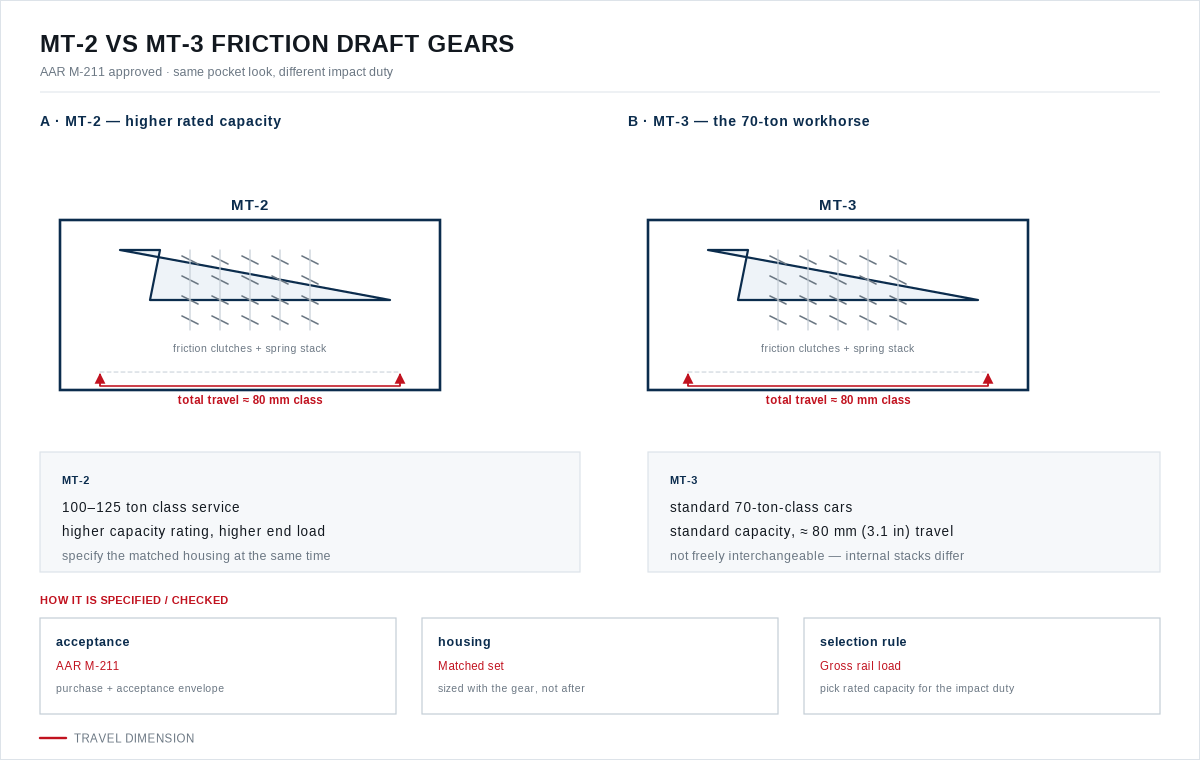
A draft gear is the shock absorber between the coupler and the wagon underframe. On each coupling or braking event it compresses, turning impact energy into friction and spring force so the car body and lading are not damaged. A friction-spring gear such as MT-2/MT-3 uses friction clutches backed by spring stacks to give both a soft initial stroke and a high end-load capacity.
Because the gear lives inside a housing that is itself a safety-critical casting, the gear and housing are designed as a matched set. Sizing the gear is therefore inseparable from sizing the draft gear housing casting.
Travel and Capacity: MT-2 vs MT-3
Travel is the distance the gear compresses at full rated load; capacity is the energy it absorbs. An MT-3 gear provides roughly 80 mm (about 3.1 in) of total travel and is the workhorse unit for standard 70-ton-class cars, while the MT-2 is selected where a higher rated capacity is required for heavier 100-ton and 125-ton service. The two are not freely interchangeable because their internal stacks and end loads differ.
| Feature | MT-2 | MT-3 |
|---|---|---|
| Typical service | 100–125 ton class | 70-ton class |
| Total travel (rated) | ~80 mm class | ~80 mm (≈3.1 in) |
| Capacity rating | higher | standard |
| Acceptance | AAR M-211 | AAR M-211 |
The practical reading is simple: pick the gear whose rated capacity matches the wagon's gross rail load and impact duty, and specify the matching housing at the same time.
Fitting a 1520 mm Freight Wagon
A 1520 mm CIS wagon normally runs an SA-3 coupler, and that coupler is paired with a friction-spring draft gear of the MT-2/MT-3 family sized to the car's axle load. Gauge alone does not decide the gear — a 25 t axle-load wagon uses the unit its impact-duty rating calls for, and a higher-tonnage car steps up to the higher-capacity gear rather than to a different profile.
This is where the two systems must stay matched: the SA-3 tail and housing locate the gear, so the gear's outer dimensions and end-wall loads must agree with the housing the foundry supplies. A mismatched gear-housing pair risks preload loss and reduced shock protection.
Housing Compatibility and Upgrades
Operators sometimes ask whether an MT-2 housing can be "upgraded" to take an MT-3 gear. The answer is no simple swap. The housings differ in internal clearances, end-wall thickness and load-path geometry, so the correct conversion is a matched housing-and-gear set, not an internal change. The housing is therefore ordered and supplied as a pair with its gear.
For fleet upgrades this means planning the housing change together with the gear, and confirming the draft-gear pocket dimensions of the wagon underframe. SIMIS casts the housings to the applicable drawing and documents them with per-heat material certificates, so the housing a buyer receives is the one the chosen gear expects.
Sourcing the Housings
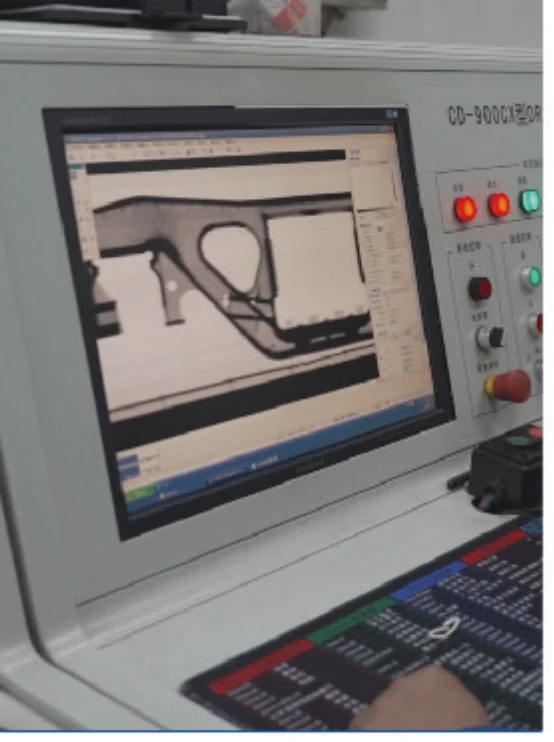
SIMIS produces draft gear housing casting on the German HWS V-process line, refining the steel by EBT and LF duplex refining — the refining route explained in EBT LF duplex refining — then normalizing and tempering, CNC machining and inspecting by UT/MT plus 9MeV CT/DR. Each housing ships with the factory material certificate, fully compliant with EN 10204 3.1, heat number and serial.
Because MT-2 and MT-3 housings are type-specific, the tooling position is confirmed per enquiry, and indicative lead time and MOQ are stated in the quotation. SIMIS supports railway castings supplier Russia and CIS programmes with the documentation needed for EAEU acceptance.
FAQ
How much travel does an MT-3 draft gear have?
An MT-3 friction-spring draft gear provides roughly 80 mm (about 3.1 in) of total travel at its rated capacity, absorbing coupling and braking shocks through a combination of friction clutches and spring stacks. The exact figure is confirmed on the type test report referenced in the AAR acceptance documentation.
Which draft gear fits a 1520 mm freight wagon?
A 1520 mm CIS wagon equipped with an SA-3 coupler normally pairs the coupler with an MT-2 or MT-3 class friction-spring draft gear sized to the car's axle load. The choice follows the wagon's impact-duty rating, with the heavier-rated unit selected for higher tonnage rather than by gauge alone.
Can an MT-2 housing be upgraded to MT-3?
Not by a simple swap. MT-2 and MT-3 use housings with different internal clearances and end-wall load paths, so converting one to the other requires the matched housing and gear set, not just an internal change. The housing is therefore selected and supplied as a pair with the gear.
Related
Get a Quotation
Send the draft gear type and the gauge with the housing drawing, drawing number or part number to sales@simisrail.com. SIMIS confirms receipt within 1 working day and returns a formal quotation within 3 working days, with indicative lead time and MOQ confirmed in the quotation. For urgent replacement programmes, contact Felix on WhatsApp at +86-13934165890.
Technical Review
For a question on the MT-2 and MT-3 draft gear, contact Felix at sales@simisrail.com or +86-13934165890.