
Process & products
SA-3 Coupler System: Parts, Yokes and Draft Gear
The SA-3 automatic coupler equips 1520 mm CIS wagons with a head, tail, draft gear and housing. Learn its castings, yoke counterpart and mixing limits.
Published: · Last updated: · Reviewed by Hou Zhiling
The SA-3 automatic coupler is the standard head-end connection across the 1520 mm CIS network — Russia, Kazakhstan, Belarus and the broader EAEU. It is a single rigid coupler head with an integrated tail, a friction-spring draft gear behind it, and a housing that anchors the assembly to the wagon underframe. Unlike the AAR knuckle coupler, the SA-3 couples automatically on contact and stays rigid in both tension and compression. For any builder or operator on 1520 mm track, knowing its castings and its limits is essential before sourcing spares.
What the SA-3 Assembly Contains
A complete SA-3 coupler set has four functional elements: the coupler head with its tail (хвостовик), the draft gear (поглощающий аппарат) that absorbs shock, the draft gear housing (корпус аппарата) that contains the gear, and the support bracket tying the housing to the centre sill. The head transfers traction and braking forces; the tail sits inside the housing and bears against the draft gear; the gear and housing together manage impact energy.
This layout is compact and fully automatic, which is why it dominates CIS freight. The rigid-head principle contrasts with the AAR articulated knuckle, and that contrast drives every interchange and mixing rule below.
The Castings in the System
Two cast steel parts dominate the SA-3 bill of material. The first is the coupler head itself — the large casting carrying the head contour, the tail and the locking recess. The second is the draft gear housing, the box-section casting that holds the draft gear and bolts to the wagon. Both are thick-section safety-critical castings that must meet the toughness and NDT demands of CIS service.
Supporting forgings and the draft gear internals complete the set, but the head and housing are the castings a foundry is asked to supply. They are produced to the relevant GOST coupling-system requirements, and each ships with a heat number and serial for traceability.
SA-3 Yoke Counterpart and Draft Gear
Operators familiar with AAR hardware often ask where the yoke is. In an AAR coupler, a separate yoke holds the coupler tail against the draft gear. The SA-3 has no free yoke: the coupler tail (хвостовик) is enclosed directly in the draft gear housing, and the housing performs the locating and retention function the AAR yoke would otherwise provide.
The draft gear behind the tail is the energy-absorbing element, typically a friction-spring unit rated for the wagon's impact duty. Because the tail and housing are sized together, the draft gear and its housing must be matched as a pair — another reason SA-3 parts are not swappable with AAR equivalents.
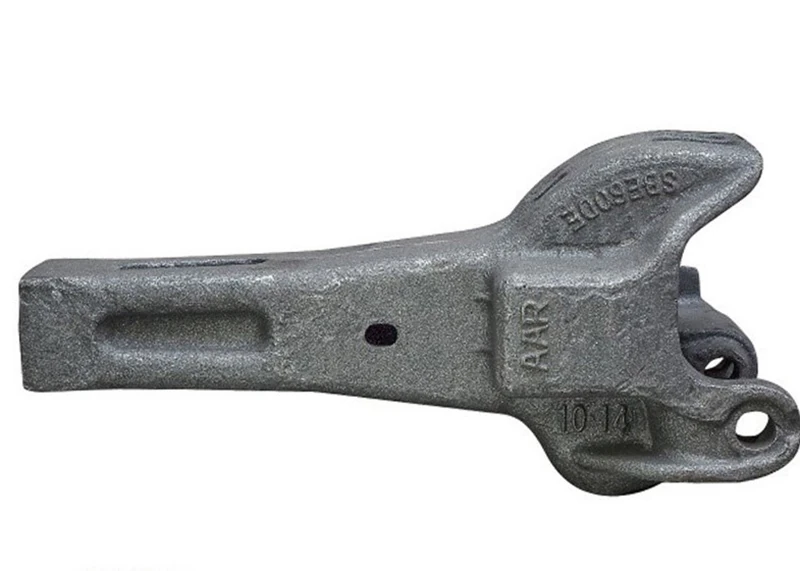
On the wagon side of the assembly, two further castings complete the load path. The follower plate, also called the draft plate, is the moving wear part inside the draft gear housing; it travels with the gear and carries the reversing shock. The follower seat, also called the draft lug or draft stop, is a static cast block welded or riveted to the centre sill draft beam; it stops the buffer and passes draw and buff load into the wagon body. Buyers in Central Asia and Russia often ask for the follower seat under coupler and draft gear, because it sits in the same assembly as the buffer, but the follower seat is supplied as a wagon body and auxiliary casting. The formal name of the impact seat is the coupler striker, so a follower seat is never an impact seat.
Why SA-3 and AAR Parts Do Not Mix
The SA-3 is dimensioned for 1520 mm gauge and a specific head profile, while AAR Type E/F couplers are built for 1435 mm gauge with a different contour and a different draft-gear interface. Their heads, tails, housings and draft gears are not dimensionally or functionally interchangeable. A mixed assembly would misalign the coupling plane and could fail to transmit load safely.
This is why procurement must keep the two systems in separate spare pools. A CIS operator sources SA-3 heads and housings; a North American operator sources AAR Type E/F bodies, yokes and draft gears. Cross-listing the two as "interchangeable coupler castings" is a documentation error with safety consequences.
Production and Tooling at SIMIS
SIMIS casts SA-3 heads and housings on the German HWS V-process line, refining the steel by EBT and LF duplex refining before pour and heat-treating it normalized and tempered. After CNC machining of the mating faces, each part is inspected by UT and MT and verified volumetrically by 9MeV industrial CT/DR, then documented with the factory material certificate, fully compliant with EN 10204 3.1, heat number and serial.
For this product family, tooling readiness shortens the path to series supply. SIMIS provides AAR Type E, Type F, 13B, and Russian SA-3 coupler castings with ready patterns/tooling, significantly eliminating pattern development costs and shortening lead times for global railcar builders. SA-3 heads and housings are produced on that existing tooling, with indicative lead time and MOQ confirmed in the quotation.
FAQ
Which castings make up an SA-3 coupler assembly?
The SA-3 assembly is built from the coupler head with its tail (хвостовик), the draft gear (поглощающий аппарат), the draft gear housing (корпус аппарата) that carries it, and the bracket that ties the housing to the wagon. The head and the housing are the two primary cast steel components.
Can SA-3 castings be mixed with AAR coupler parts?
No. SA-3 is dimensioned for 1520 mm gauge with a different head profile and draft-gear interface than AAR Type E/F hardware, so its head, tail and housing are not interchangeable with AAR coupler bodies, yokes or draft gears. Mixing them would break the coupling geometry.
What is the SA-3 counterpart of a coupler yoke?
The AAR coupler yoke is replaced in the SA-3 system by the tail piece (хвостовик) seated inside the draft gear housing. The housing itself performs the yoke's role of locating the coupler against the draft gear, so there is no separate free yoke as in the AAR arrangement.
Does SIMIS have existing tooling for SA-3 coupler castings?
Yes. SIMIS provides AAR Type E, Type F, 13B, and Russian SA-3 coupler castings with ready patterns/tooling, significantly eliminating pattern development costs and shortening lead times for global railcar builders. SA-3 heads and housings are produced on that existing tooling with EBT/LF refined steel and full NDT.
Related
- railway coupler body casting
- railway coupler and draft gear castings
- railway castings supplier Russia and CIS
Get a Quotation
SIMIS provides AAR Type E, Type F, 13B, and Russian SA-3 coupler castings with ready patterns/tooling, significantly eliminating pattern development costs and shortening lead times for global railcar builders. Send your drawing or specification to sales@simisrail.com; SIMIS confirms within 1 working day and returns a quotation within 3 working days, with indicative lead time and MOQ confirmed in the quotation. Contact Felix on WhatsApp at +86-13934165890.
Technical Review
The boundary between what a standard covers and what it does not is stated explicitly. For a question on how the SA-3 coupler system applies to a specific drawing, contact Felix at sales@simisrail.com or +86-13934165890.