
Failure & inspection
When to Replace a Bogie Bolster: Rejection Criteria
A bogie bolster is replaced on any crack at the side-frame connection, centre bowl or wedge pocket, or on wear beyond the restoration limit. See AAR.
Published: · Last updated: · Reviewed by Fan Yaoqiang
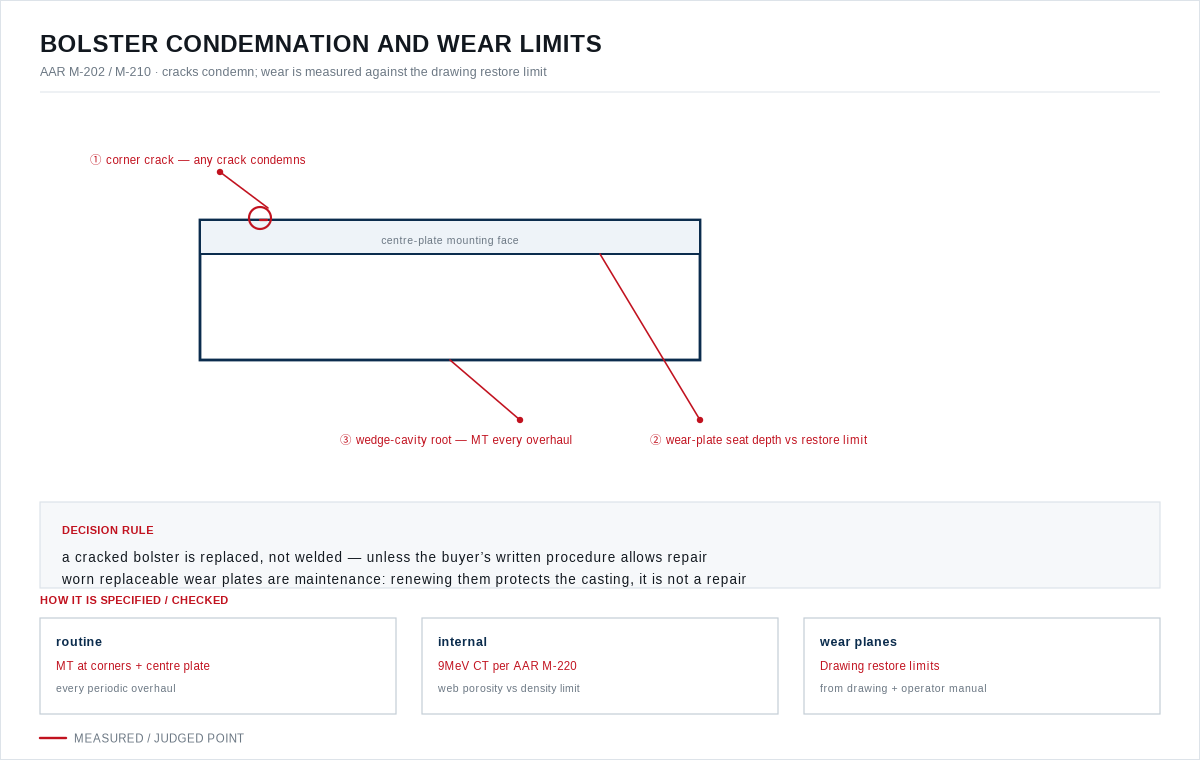
A bogie bolster is condemned and replaced on any crack at the side-frame connection, centre bowl or wedge-pocket root, on internal porosity in the web above the soundness limit, or on wear at the centre bowl, column wear-plate seat or spring nest beyond the stated restoration limit. SIMIS builds bolsters to AAR M-202 and M-210; service limits are read from the drawing and the operator's maintenance manual.
Bolster Rejection Criteria: Location, Limit and Detection
Bolsters are inspected for cracks, internal soundness and section loss. This table lists the conditions that condemn a bolster and the inspection that establishes each one.
| Failure mode / rejection condition | Consequence or cause | Detection method | Disposition |
|---|---|---|---|
| Corner crack at the side frame connection | Any indication | Magnetic particle | AAR M-202 and M-210 |
| Centre bowl crack | Any indication | UT plus magnetic particle | AAR M-202 and M-210 |
| Wedge pocket root crack | Any indication | Magnetic particle | AAR M-202 and M-210 |
| Internal porosity in the web | Above the internal soundness limit | 9MeV industrial CT | AAR M-220 |
| Centre bowl wear | Beyond the stated restoration limit | Dimensional measurement | AAR M-210 |
| Column wear plate seat wear | Beyond the stated restoration limit | Dimensional measurement | AAR M-210 |
| Spring nest wear | Beyond the stated restoration limit | Dimensional measurement | AAR M-210 |
Important. A replaceable wear plate or liner protects the bolster and is not a repair of the casting. A cracked bolster is replaced, not welded, unless the buyer's written procedure permits it.
Why Bolster Locations Crack or Wear
The corner at the side-frame connection, the centre bowl and the wedge-pocket root all sit in the load path and see impact and alternating stress, so any crack there is a reject. Wear at the centre bowl, column wear-plate seat and spring nest is gradual and measured to the drawing limit; a worn wear plate is renewed, which protects the casting rather than repairing it.
Two of these locations belong to other products, and the distinction matters when a buyer orders a replacement. The centre bowl is the working surface of the lower center plate, which is a bogie casting, while the upper center plate that rides on it is supplied as a wagon body and auxiliary casting. The wedge pocket is the seat that receives the friction wedge, and the friction wedge is also a bogie casting supplied in a matched set with the bolster and the side frame column. A cracked bolster is therefore not repaired by ordering a wedge or a centre plate: those are separate parts, and the bolster casting itself is replaced.
Inspection Equipment and Shop Practice
Shops use magnetic particle (MT) at the corner, centre bowl and wedge-pocket root, and add ultrasonic (UT) at the centre bowl where section allows. Internal web porosity is confirmed by 9MeV industrial CT per AAR M-220. Dimensional wear is measured against the restoration limits. SIMIS ships new bolsters with MT/UT reports and the factory material certificate, fully compliant with EN 10204 3.1 matching the original acceptance basis.
Acceptance, Records and Replacement
Replacement is logged against the car and the bolster serial and heat numbers. As with side frames, wear limits come from the drawing and maintenance manual. SIMIS retains the manufacturing records so a replacement bolster's test data is available for the contract period.
Frequently Asked Questions
Which bolster cracks are repairable?
Under AAR M-202 and M-210 any crack at the side-frame connection corner, centre bowl or wedge-pocket root is a reject — there is no allowable crack in the load path. A cracked bolster is replaced, not welded, unless the buyer's written procedure explicitly permits repair. A worn replaceable wear plate or liner is renewed, which is maintenance, not a casting repair.
What is the minimum remaining web thickness?
The minimum remaining web thickness is the value stated in the drawing and the operator's maintenance manual for the specific bolster design; it is not a single generic number. Dimensional measurement at the worn web establishes the condemnation when wear reaches that limit. SIMIS builds to AAR M-202 and supplies the as-cast and machined reference dimensions for verification.
How often are bolsters inspected in service?
Bolsters are inspected at each periodic overhaul of the truck, with magnetic particle at the corner, centre bowl and wedge-pocket root and ultrasonic at the centre bowl. Internal soundness of suspect units is confirmed by 9MeV CT per AAR M-220. The exact interval follows the operator's maintenance schedule and the car's service severity, not a fixed foundry figure.
Related Reading
Request a Quotation
Send your bolster drawing and maintenance standard to sales@simisrail.com. SIMIS confirms receipt within 1 working day and returns a quotation with indicative lead time and MOQ for replacement bolsters built to AAR M-202 and M-210.
Technical Review
For a question on bolster rejection criteria, contact Felix at sales@simisrail.com or +86-13934165890.