

Standards & materials
Follower Plate vs Follower Block: The Draft Gear Stack
The follower plate and follower block sit between the draft gear housing and the yoke. Learn which part travels, how it affects gear travel, and why wear.
Published: · Last updated: · Reviewed by Hou Zhiling
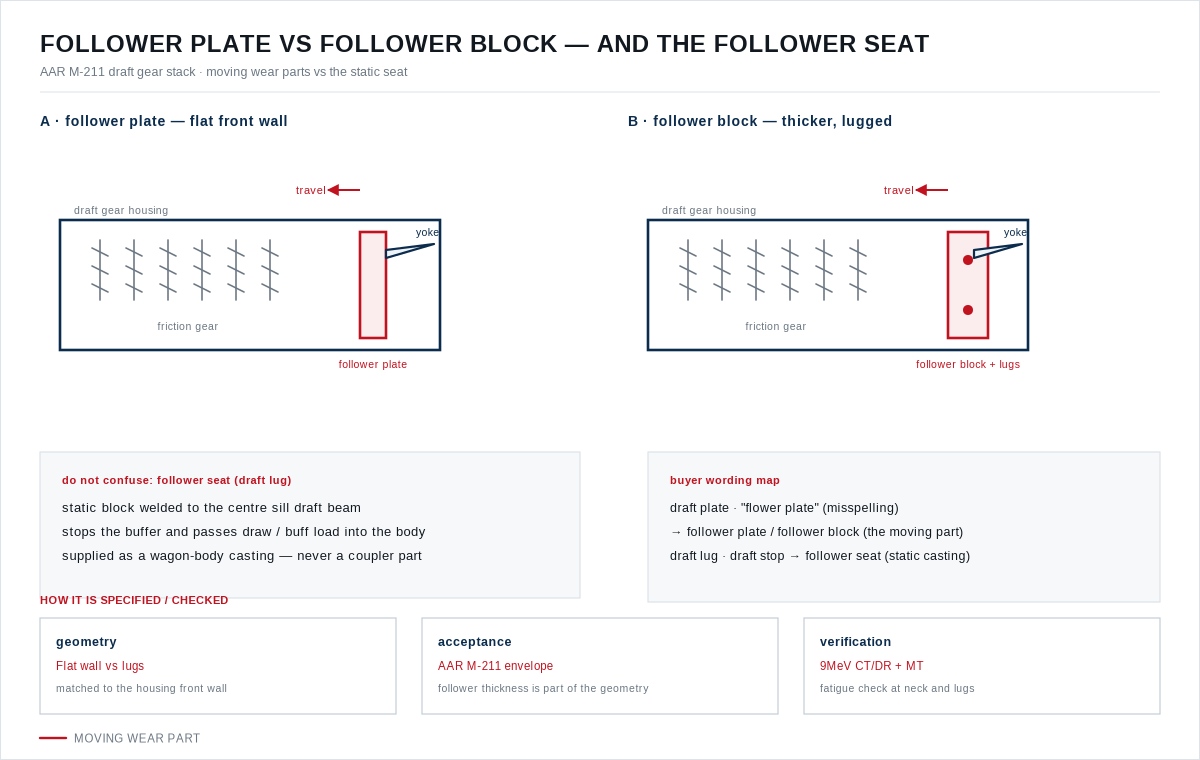
The follower plate and follower block sit between the draft gear housing and the yoke, and both carry the reversing load through the travel of the gear. The difference is form: a follower plate is a flat front wall, a follower block is a thicker, often lugged piece. SIMIS casts both as coupler draft-gear components to AAR M-211 limits, and each is matched to the housing it runs in. Neither of them is the follower seat: the follower seat is a separate static cast block, and the two are regularly confused on enquiry.
Follower Plate versus Follower Block
| Aspect | Follower plate | Follower block |
|---|---|---|
| Form | Flat front wall | Thicker, may carry lugs/bolt holes |
| Travel role | Wear face against housing | Wear face, also locates the gear |
| Typical use | Standard draft gear stacks | Gear designs needing locating lugs |
| Matching rule | To the housing front wall | To the housing and bolt pattern |
The two are alternative geometries of the same moving wear part in the draft gear stack.
Follower Plate and Follower Seat: Two Different Parts
| Aspect | Follower plate (follower block) | Follower seat (draft lug) |
|---|---|---|
| Movement | Travels inside the draft gear housing | Static; welded or riveted to the centre sill draft beam |
| Function | Closes the gear against the yoke and takes the reversing shock | Stops the buffer and passes draw and buff load into the wagon body |
| Catalogue family | Coupler and draft gear castings | Wagon body and auxiliary castings |
| Buyer wording | draft plate, front or rear follower plate, flower plate (common misspelling) | draft lug, draft stop, front or rear follower seat |
The follower plate is the moving wear part; the follower seat is the fixed base it works against. Note also that the official name of the impact seat is the coupler striker, so a follower seat is never an impact seat. Buyers in Central Asia and Russia often request follower seats under coupler and draft gear, but the seat is supplied as an underframe casting.
Technical Mechanism: The Draft Gear Stack
In the coupler draft gear assembly the housing is fixed to the draft sill, the gear sits inside it, and the follower closes the front against the yoke. Under drawbar load the gear compresses and the follower travels a small distance against the housing front wall. AAR M-211 defines the coupler and draft-gear acceptance envelope, and the follower thickness is part of that geometry.
The follower carries the reversing shock through the gear travel, so its wear face, neck and lug holes are the fatigue and impact points. Because the follower travels against the housing, its thickness sets the free travel and the snubbing point: too thin gives excessive free travel, correctly matched keeps travel within design. The follower is therefore specified against the housing it runs in, not by nominal size alone.
Production Equipment and Process Control
Followers are poured on the German HWS V-process vacuum sand casting line, which holds the wear face and any lug or bolt-hole contour to the tolerances the draft gear stack needs. EBT + LF duplex refining limits inclusions that would seed a fatigue crack at the follower neck.
Each casting is verified by 9MeV industrial CT/DR volumetric scanning and by UT/MT/PT before CNC machining of the wear face and holes. Normalising and tempering delivers the toughness the reversing shock load demands, with furnace records tied to the heat number.
Inspection, Acceptance and Traceability
Every follower ships with the factory material certificate, fully compliant with EN 10204 3.1, a heat number and an individual serial number. NDT reports are filed against that serial so a depot can trace a chipped or cracked follower back to its melt and inspection record.
Because the follower is matched to its housing, SIMIS supplies it against the specific housing specification and draft gear type the fleet runs, so the wear face and clearance are correct at fitting rather than discovered to mismatch at assembly.
Typical Failure Modes and Detection Methods
The follower assembly sits between the draft gear housing and the yoke, and carries the reversing load through the travel of the gear. This table maps the failure mode to its cause and to the inspection that identifies it. All rows refer to the moving follower plate; the static follower seat is a separate underframe part.
| Failure mode / rejection condition | Consequence or cause | Detection method | Disposition |
|---|---|---|---|
| Wear on the follower plate face | Normal travel against the housing front wall | Dimensional measurement of thickness | Replace the follower plate |
| Edge chipping | Impact during coupling shock | Visual | Replace the follower plate |
| Crack at the follower plate neck | Fatigue from reversing load | Magnetic particle | Replace the follower plate |
| Sticking in the housing | Corrosion or galling on the housing face | Visual at disassembly | Clean or replace the housing face |
| Excessive free travel | Incorrect follower plate thickness for the housing | Dimensional measurement against the housing specification | Match the follower plate to the housing, not the reverse |
| Lug or bolt hole elongation | Repeated shock load | Dimensional measurement | Replace the follower plate, check the bolts |
Important. Follower plate wear is matched to the housing it runs in. Specifying a follower plate by its nominal size alone, without the housing it will run in, is the most common cause of a mismatch at assembly.
Important. The follower seat is not covered by this table. It is a static casting welded or riveted to the centre sill draft beam, so it is inspected for weld integrity, base cracking and distortion rather than for travel wear.
FAQ
Which part actually travels inside the draft gear housing?
The follower (plate or block) travels inside the housing as the draft gear compresses under drawbar load. It is the wear face that rides against the housing front wall during the gear's travel, while the yoke behind it transmits the load. The follower is the moving wear part; the housing is the fixed boundary it runs against.
How does the choice affect draft gear travel?
Follower thickness sets the free travel and the snubbing point of the gear. A follower that is too thin gives excessive free travel; one matched to the housing specification keeps travel within design. Specifying the follower by nominal size alone, without the housing, causes mismatch at assembly and changes the travel the gear was qualified to.
How do wear pairs interact with the housing?
The follower wear face must match the housing front-wall contour it runs in; corrosion or galling on the housing face makes the follower stick, and a wrong follower thickness changes the clearance. The follower is matched to the housing it runs in, not specified in isolation, which is why the housing and follower are ordered and fitted as a matched pair.
Are the follower seat and the follower plate the same part?
No. The follower plate is the moving wear part inside the draft gear housing, while the follower seat is the static base casting welded or riveted to the centre sill draw beam, which takes the housing reaction and carries the buff and draft load into the wagon body. Central Asian and Russian buyers often quote the follower seat under the coupler and draft gear family, but the seat belongs to wagon body and auxiliary castings.
Related
- draft gear follower plate casting
- railway follower seat casting
- draft gear housing casting
- railway coupler and draft gear castings
CTA
Send your follower and housing drawing with the draft gear type to sales@simisrail.com. SIMIS confirms receipt within 1 working day and returns a quotation within 3 working days, stating housing-matched supply, indicative lead time and MOQ.
Technical Review
For a question on the follower plate and follower block, contact Felix at sales@simisrail.com or +86-13934165890.