
Process & products
German HWS V-Process Casting for Heavy Castings
What V-process casting is and why heavy railway castings use it. V-process vs resin sand and lost foam, and the German HWS automated line.
Published: · Last updated: · Reviewed by Wang Yan
V-process casting (vacuum molding) is a binderless sand process where dry silica sand is held in shape by a plastic film under vacuum. It is the preferred route for large heavy railway castings because it removes mold-wall erosion and binder gas, the two main sources of sand inclusions and gas porosity. SIMIS runs a German HWS automated V-process line giving heavy bogie and coupler parts repeatable geometry with minimal machining allowance.
V-Process vs the Alternatives at a Glance
| Feature | V-process | Resin sand | Lost foam |
|---|---|---|---|
| Binder | None (vacuum + film) | Chemical resin | Foam pattern + coating |
| Gas porosity risk | Very low | Moderate | Moderate (coating) |
| Mold-wall erosion | Eliminated | Possible | Low |
| Surface finish | Excellent | Good | Fair |
| Suited for | Large heavy parts | General production | Complex thin sections |
The table shows why size favors V-process: the defects it removes are exactly the ones that worsen as castings get larger and section transitions get thicker.
Why Heavy Railway Castings Use V-Process
Heavy railway castings — bolsters, side frames, bearing adapters, coupler bodies — have thick-to-thin section transitions and tight geometric tolerances. Two failure modes dominate conventional molding at this scale.
Mold-wall erosion: high-velocity molten steel washes loose sand from the mold face, trapping inclusions that become fatigue stress centers. Binder gas: moisture and chemical binders in green or resin sand release volatile gas on contact with steel, forming pinholes along wear faces.
V-process avoids both. Dry, binderless sand is consolidated by vacuum under a smooth plastic film, so there is nothing to wash away and nothing to outgas. The result is an evenly stressed, dimensionally repeatable blank that distributes track loads uniformly.
V-Process vs Resin Sand and Lost Foam
Resin sand molding binds sand with chemical resins; those resins decompose and release gas during the pour, raising the risk of gas porosity and leaving a rougher, binder-affected surface. Lost foam uses a polystyrene pattern that the steel vaporizes as it fills the cavity — convenient for complex shapes, but it can leave carbon residues and coating defects if the coating is incomplete.
V-process uses neither a chemical binder nor a consumable pattern. Only dry sand shaped by a plastic film and held by atmospheric pressure does the work. Gas generation falls to near zero, mold-wall erosion is eliminated, and the casting emerges with a smooth surface and tight tolerances that cut downstream CNC machining.
Production Equipment: the German HWS Automated Line
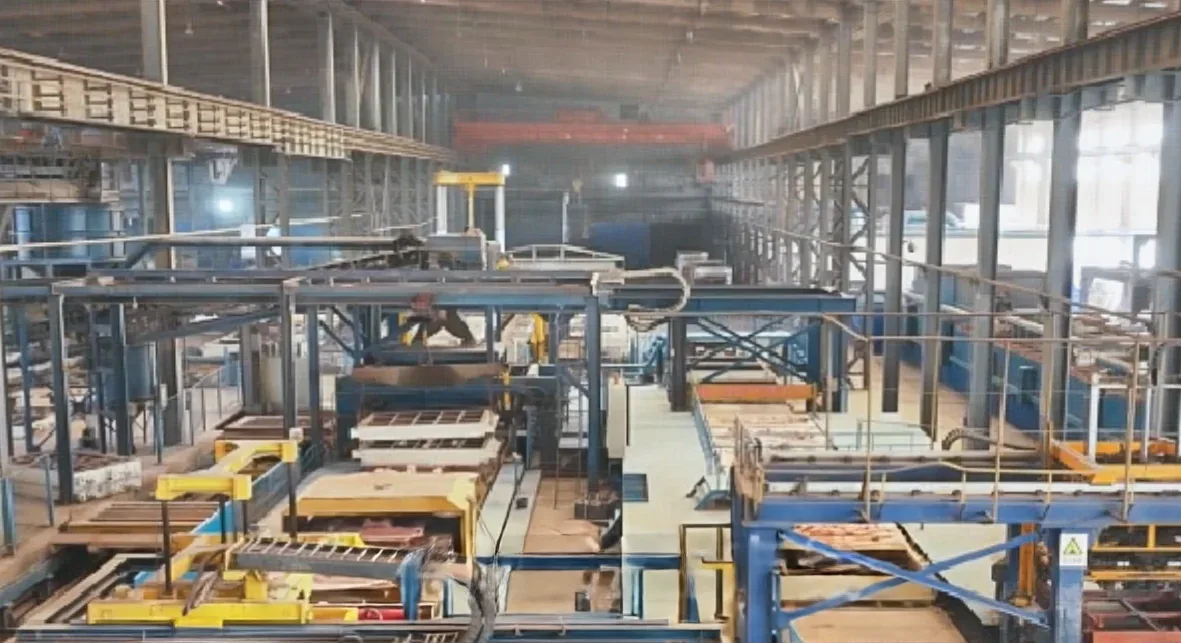
SIMIS operates an imported German HWS automated V-process vacuum molding line. The automation delivers consistent film placement, sand fill, and vacuum sealing part after part, which is what makes the process repeatable on heavy castings rather than craft-dependent.
Because the blank arrives clean and dimensionally tight, CNC machining allowance is minimized, and locking slots, curved bearing seats, and keyways integrate without loose clearance. The line handles the large flasks and high sand weights that heavy bogie and coupler parts require, supporting global interchangeability.
Acceptance and Traceability
V-process castings are verified like any safety-critical part. Every casting ships with the factory material certificate, fully compliant with EN 10204 3.1 recording the heat number and mechanical results, and a single-piece serial number links it to its melt. Internal soundness is checked by 9MeV CT on thick sections, with UT and MT on specified surfaces. Acceptance follows the applicable AAR or GOST limits, subject to the buyer's third-party inspection and MTC review.
FAQ
Which casting process suits large heavy railway castings?
For large heavy railway castings, V-process vacuum molding is generally the preferred route because its binderless, dry-sand system removes the two defects that scale badly with size — mold-wall erosion and binder-gas porosity. Resin sand and lost foam remain useful for smaller or highly complex parts, but V-process gives the repeatable geometry and low machining allowance that heavy bogie and coupler parts need.
How does V-process compare with resin sand and lost foam?
Resin sand uses chemical binders that release gas on pour, raising porosity risk; lost foam burns a foam pattern that can leave carbon and coating defects. V-process uses no binder and no foam — only dry sand held by vacuum under a plastic film — so gas generation drops to near zero and mold-wall erosion is eliminated, giving a cleaner, smoother casting.
Does V-process eliminate casting porosity entirely?
No process eliminates porosity entirely; V-process sharply reduces the gas- and sand-related portion by removing binders and mold-wall erosion, but shrinkage and design-related porosity still depend on gating, risering, and clean steel. SIMIS therefore pairs V-process molding with EBT+LF duplex refining and 9MeV CT to catch any remaining internal voids.
Related
Contact SIMIS
SIMIS Precision Casting Co., Ltd. runs a German HWS V-process line for heavy railway castings with EBT+LF duplex refining and 9MeV CT verification. Send the casting weight and the section thickness with the drawing, drawing number or part number to sales@simisrail.com. or reach Felix on WhatsApp / mobile +86-13934165890; we confirm receipt within 1 working day and return an indicative quotation for your review.
Technical Review
For a question on the HWS V-process line, contact Felix at sales@simisrail.com or +86-13934165890.