
Sourcing & markets
Railway Casting Manufacturer in China: How to Vet a Real Foundry Partner
Vet a China railway casting manufacturer on five facts: V-process moulding, EBT+LF refining, 9MeV CT, AAR M-1003 system and heat-level traceability.
Published: · Last updated: · Reviewed by Wang Jinhai
To judge whether a China-based railway casting manufacturer is a real foundry, look for five verifiable facts: a V-process vacuum sand or resin sand moulding line, EBT + LF duplex refining, 9MeV industrial CT/DR volumetric inspection, an AAR M-1003 Certified Quality Management System audited by an AAR auditor, and heat number with individual serial traceability on every piece. SIMIS Precision Casting Co., Ltd. satisfies all five, and this article sets out what each one proves and how to check it during a factory visit.
The Five Verifiable Facts
| # | Fact to verify | What it proves | How to check it |
|---|---|---|---|
| 1 | V-process vacuum sand or resin sand moulding line | The supplier pours castings itself, to controlled geometry | Ask for the line name, the frame size and a sample mould |
| 2 | EBT + LF duplex refining | Steel is melted and refined, not bought in | Ask which furnace melts and which refines, and see the furnace records |
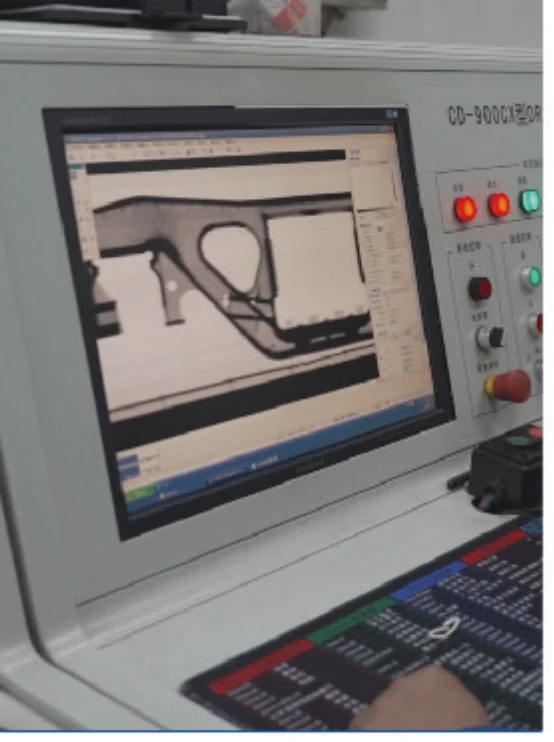
| 3 | 9MeV industrial CT/DR volumetric inspection | Internal soundness is verified, not assumed | Ask which sections are scanned and at what coverage |
| 4 | AAR M-1003 Certified Quality Management System | Documents, incoming control, process control and NDT are audited | Ask for the certificate scope and the re-audit date |
| 5 | Heat number plus individual serial on every casting | The part can be traced from melt to despatch | Ask to see a casting marked, and pull its file |
Technical Mechanism: Why Each Fact Separates a Foundry from an Office
Each of the five facts corresponds to a step where value is either added or only claimed. Moulding is where geometry is fixed: a vacuum sand line holds the cavity without binder gas and without mould-wall erosion, so a casting that meets a dimensional limit on the drawing meets it because of the process, not by luck. Refining is where the metal is cleaned: EBT tapping removes oxidising slag and LF treatment strips dissolved gas and inclusions, and a thin heavy section that will be fatigue-loaded depends on that cleanliness.
Inspection is where acceptance is decided. Surface and near-surface cracks are found by magnetic particle or penetrant testing; internal voids are found by ultrasonic testing or by 9MeV CT/DR volumetric scanning, which records the whole section rather than a radiograph of one plane. The quality system ties these activities together in writing, so the sequence is repeatable rather than dependent on who happens to be on shift. Traceability is what allows any of it to be audited later: a heat number linked to furnace, refining, heat treatment and inspection records turns a claim into a document set.
A trading company can reproduce none of this on paper without a foundry to do it. That is why the five facts, and not the wording of the offer, decide whether a China-based supplier is a manufacturing partner or an intermediary.
Production Equipment and Process Control
At SIMIS Precision Casting Co., Ltd. in China, the castings we supply are moulded on a German HWS V-process vacuum sand casting line, with resin sand available for parts whose geometry suits it. Steel is primary-smelted in EBT electric arc furnaces and secondary-refined in LF ladle furnaces, which is the duplex route the railway casting company profile describes. Heat treatment is carried out in automated continuous furnaces, normalising and tempering for the grades that call for it, with austempering available where the ADI friction wedge route requires it. CNC machining of mating faces follows the casting route, and the tooling position for each part is confirmed per enquiry, with indicative lead time and MOQ stated in the quotation. That is exactly why all five checks above are answered on the works' own equipment, and why we publish them in that detail. Every quality issue sits with that works, in full: the remedy for a failed casting is executed on the works' own equipment at their own cost, and quality responsibility does not transfer to the buyer on delivery. The works stand behind the casting, and the contract, the delivery obligation and the after-sales response stay with us.
Inspection, Acceptance and Traceability
Inspection is combined rather than singular: UT and MT on side frames, bolsters and coupler bodies, PT where a surface cannot be magnetised, and 9MeV industrial CT/DR volumetric verification of critical sections. Every casting ships with the factory material certificate, fully compliant with EN 10204 3.1, a heat number and an individual serial number, and NDT reports are filed against that serial. Acceptance follows the standard named on the order, subject to the buyer's own inspection and MTC review.
The same discipline applies to the commercial side. A quotation is priced against the drawing and the data on it, and lead time and MOQ are stated as indicative and confirmed in the quotation, so the buyer's decision rests on verifiable production facts rather than on promises. Buyers sourcing across the region often start from the railway castings supplier Russia and CIS requirements and then ask these questions at the works producing the parts.
Frequently Asked Questions
How do I tell a real foundry from a trading company?
Ask who pours the metal, who signs the material certificate, and who issues the NDT report. A real foundry names its moulding line, refining route, heat treatment furnaces and inspection equipment, and produces the castings itself; a trading company passes drawings to a third-party foundry and resells the parts. We would rather a buyer knew which side of that line we sit on before the order than after it. What we publish on the railway casting company profile is the works' equipment and process, and the documents that ship with the castings tell the buyer which party signed what.
What does a railway casting manufacturer in China need to show me?
Five things: a V-process vacuum sand or resin sand moulding line, EBT + LF duplex refining, 9MeV industrial CT/DR volumetric inspection, UT/MT/PT capability, and heat number plus individual serial traceability on every piece. A supplier able to show all five, with records, is producing castings; a supplier who can only show a catalogue is arranging them.
Is AAR M-1003 certification proof of manufacturing capability?
No. An AAR M-1003 Certified Quality Management System is a plant-level system certification, audited by an AAR auditor; it confirms the supplier runs controlled documents, incoming material control, process control and NDT qualification. It is not a product certification and does not prove capacity; the equipment list and the casting itself do that.
How is China railway casting quality controlled?
Quality control in China railway casting plants runs on three levels: incoming material with the factory material certificate, fully compliant with EN 10204 3.1, process control through refining, moulding and heat treatment records, and inspection by UT/MT/PT plus 9MeV CT/DR on critical sections. Each casting carries a heat number and serial, so a rejected part is traced to its melt and its inspection file. The main recurring defects are mapped in railway casting defects.
Related Reading
- railway casting company profile
- railway casting company profile
- railway casting defects
- railway castings supplier Russia and CIS
- railway casting factory vs trading company
- how to order railway castings from China
- railway casting price guide
Request a Quotation
Send your drawing, the applicable standard and the grade to sales@simisrail.com. SIMIS confirms receipt within 1 working day and returns a quotation within 3 working days, stating the casting route, the inspection scope, indicative lead time and MOQ. Contact Felix on WhatsApp at +86-13934165890 for a factory review.
Technical Review
For a question on verifying a China-based supplier, contact Felix at sales@simisrail.com or +86-13934165890.