
Sourcing & markets
Metre-Gauge Railway Castings in Indonesia: Supply Guide
Metre-gauge tropical freight lines in Indonesia and the region need corrosion-protected castings packed for sea freight. Learn gauge compatibility.
Published: · Last updated: · Reviewed by Wang Jinhai
Southeast Asia's freight lines run mostly on metre gauge (1000 mm) and cape gauge (1067 mm), in a humid tropical climate that punishes unprotected steel. Supplying castings to Indonesia and the region means matching the gauge at the bogie level, protecting the surface for a long sea journey, and packing to arrive clean. SIMIS supplies bogie, suspension and coupler castings for these metric-gauge, tropical services.
Metre-Gauge Supply: What the Region Runs
| Gauge | Common name | Typical SE Asia use |
|---|---|---|
| 1000 mm | Metre gauge | Indonesia, Thailand, Malaysia networks |
| 1067 mm | Cape gauge | Regional heavy lines |
| Component basis | AAR / metric bogie designs | Freight wagons and locos |
The casting itself is gauge-neutral; the bogie it fits is dimensioned to the track. Supply is therefore a question of building the right bogie around the casting, not changing the casting.
Technical Mechanism: Gauge Compatibility
A bogie's gauge is set by its wheelbase, axle spacing and journal centres — all bogie-level dimensions — while the castings (bolster, side frame, spring seat, centre plate) are the structural members the bogie is built from. An AAR three-piece bogie is a component architecture: when its wheelbase is laid out for 1067 mm, it runs on cape gauge; when laid out for 1000 mm, it runs on metre gauge.
This means a foundry does not need a "metric" version of each casting; it needs the casting to meet the material and acceptance standard (AAR M-201 for general castings, or the local/metric specification the operator requires) and to be dimensioned to the bogie drawing. The gauge question is answered at the bogie design stage, with the casting supplied to that drawing.
Production Equipment and Process Control
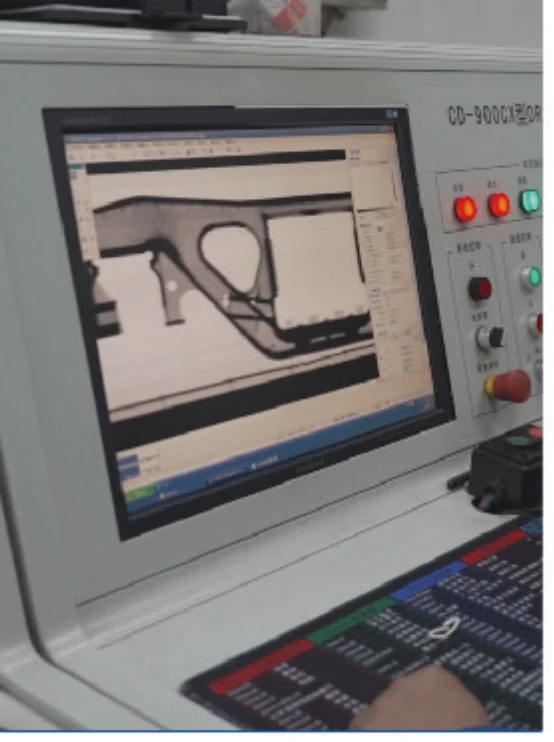
The castings are poured on the German HWS V-process vacuum sand casting line, with EBT + LF duplex refining to control inclusions, then 9MeV industrial CT/DR volumetric scanning and UT/MT/PT before CNC machining. Normalising and tempering delivers the toughness the tropical, high-humidity service environment demands.
For sea-bound supply the surface is prepared and the protection system is applied after final inspection, so the coating is laid on a clean, verified casting rather than concealing a defect.
Inspection, Acceptance and Traceability
Every casting ships with the factory material certificate, fully compliant with EN 10204 3.1, a heat number and an individual serial number, and NDT reports are filed against that serial for single-piece traceability. The acceptance documents are matched to the operator's required standard — AAR M-201 where specified, or the metric/national specification in use on the line.
Packing is confirmed against destination and transit time: VCI wrapping and sealed, framed crates with desiccant protect the parts through a humid, multi-week sea journey to Indonesia, and the indicative lead time and MOQ are stated in the quotation rather than fixed up front.
FAQ
Are AAR three-piece bogies compatible with 1067 mm gauge?
The AAR three-piece bogie is a component design, not a fixed gauge; its wheelbase and axle spacing are set to the track gauge at design. A three-piece bogie built for 1067 mm cape gauge runs on that gauge, while a metre-gauge (1000 mm) line needs the bogie dimensioned to 1000 mm. Gauge is a bogie-level design choice, not a property of the casting itself.
What coating protects castings in a humid tropical climate?
In a humid tropical climate a multi-stage protection is used: a corrosion-inhibiting primer and a top coat suited to high humidity and salt exposure, applied after the casting is cleaned and inspected. The coating plan is set against the service environment — marine and tropical exposure need a more robust system than a dry inland line.
How are castings packed for sea freight to Indonesia?
Castings are packed for sea freight with vapour-corrosion-inhibiting (VCI) wrapping and sealed, framed crates that resist humidity and handling, with desiccant where the journey is long. SIMIS confirms the packing specification against the destination and transit time so the parts arrive without surface degradation, and the indicative lead time is stated in the quotation.
Related
CTA
Send your metre-gauge bogie drawing and coating requirement to sales@simisrail.com. SIMIS confirms receipt within 1 working day and returns a quotation within 3 working days, stating packing specification, indicative lead time and MOQ for sea freight to Indonesia.
Technical Review
For a question on supplying metre gauge fleets, contact Felix at sales@simisrail.com or +86-13934165890.