
Process & products
Type E vs Type F Couplers: Interchangeability and Limits
Type E and Type F couplers share the AAR automatic head but are not knuckle-interchangeable. Learn the limits and spare-part strategy.
Published: · Last updated: · Reviewed by Hou Zhiling
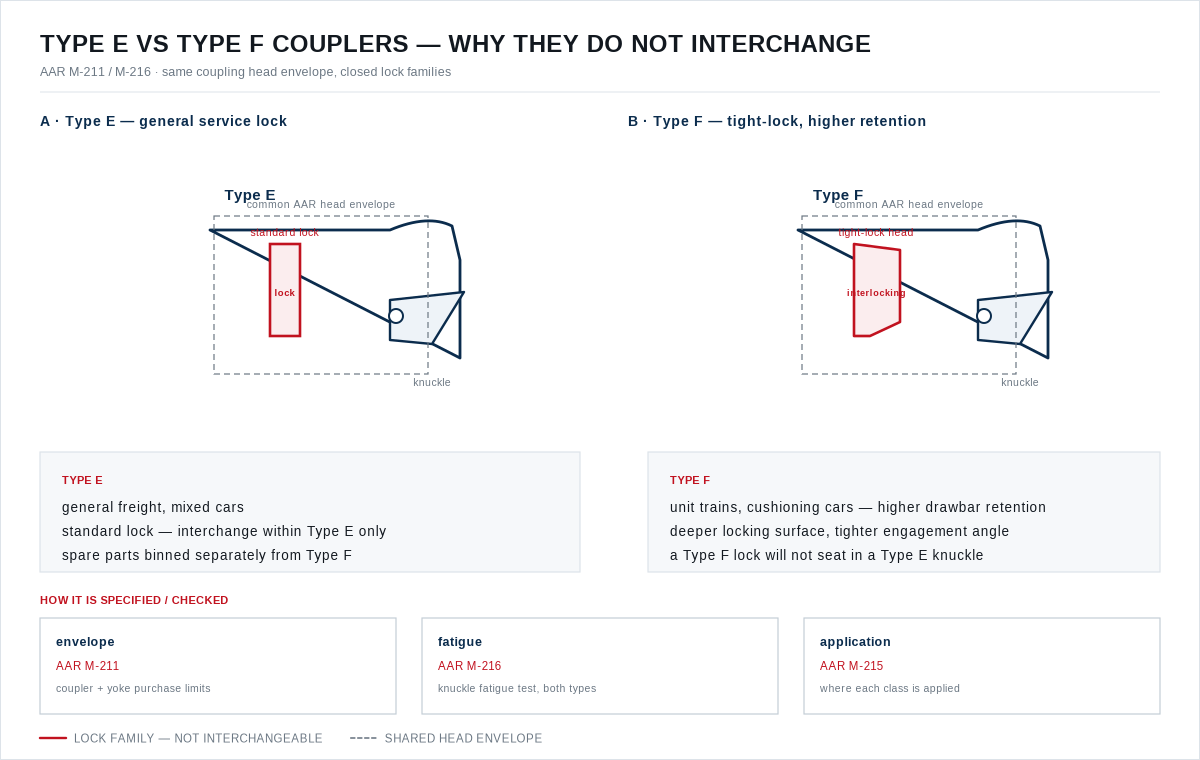
Type E and Type F couplers are both AAR automatic couplers, but their knuckles, locks and bodies are not mechanically interchangeable. Type E (per AAR M-211 / M-216) is the general-service coupler used on the majority of North American freight cars, while Type F is a tight-lock design specified for higher drawbar retention on unit trains. Mixed fleets must stock both types separately. SIMIS supplies both from existing patterns.
Type E versus Type F: A Comparison
The two couplers share the same automatic coupling head and draft-gear envelope, yet they are selected for different service duties. The table below sets out the decision-relevant differences a fleet engineer should keep in view.
| Parameter | Type E | Type F |
|---|---|---|
| Governing standard | AAR M-211, M-216 | AAR M-211, M-216 |
| Locking system | Standard lock, general service | Tight-lock, higher retention |
| Typical service | General freight, mixed cars | Unit trains, cushioning cars |
| Knuckle / lock interchange | Within Type E only | Within Type F only |
| Coupling head contour | Common AAR envelope | Common AAR envelope |
| Spare-part binning | Separate from Type F | Separate from Type E |
The practical rule is simple: the head couples to the same train, but the internal lock hardware does not cross over.
Technical Mechanism: Why the Two Designs Do Not Interchange
AAR M-211 defines the purchase and acceptance envelope for couplers and yokes, while AAR M-216 specifies the fatigue-test requirement for Type E and Type F knuckles. Within that envelope the Type F lock carries a deeper, larger locking surface and a tighter engagement angle than the Type E lock. The knuckle pivot and the lock-seat contour are therefore dimensionally distinct, and a Type F lock will not seat or retain inside a Type E knuckle.
AAR M-215, covering coupling systems, governs where each class is applied rather than how the parts physically mate. Because the lock, lock lifter and knuckle are the wear and shock-load path, intermixing them would change the engagement geometry the fatigue tests were qualified against. For this reason depots must treat the two sets as closed families: a Type E knuckle runs only with Type E lock hardware, and the same holds for Type F.
Current-Pattern Supply Capability (SIMIS)
SIMIS provides AAR Type E, Type F, 13B, and Russian SA-3 coupler castings with ready patterns/tooling, significantly eliminating pattern development costs and shortening lead times for global railcar builders.
Within the AAR system, Type E and Type F knuckles and coupler bodies are produced to the fatigue-life and dimensional limits of AAR M-211 and AAR M-216. For the Russian 1520 mm system, SA-3 coupler and draft-gear components are delivered with a mature record of sub-zero impact-toughness acceptance. Models outside the confirmed list — any coupler class not named above — are supplied on a pattern-development basis, and lead time and minimum order quantity are confirmed in the quotation rather than stated as fixed figures.
Production Equipment and Process Control
Coupler bodies and knuckles are poured on the German HWS V-process vacuum sand casting line, which holds the head and lock-seat contours to the close tolerances the M-211 envelope demands. Molten steel is refined by EBT + LF duplex refining to control sulphur and inclusions, then cooled under controlled conditions to limit internal shrinkage at the heavy shank section.
Finished castings are verified by 9MeV industrial CT/DR volumetric scanning and by UT/MT/PT surface inspection before any CNC machining of the lock seat and pivot. Heat treatment — normalising and tempering — is applied to reach the mechanical properties the coupler class requires, with furnace records tied to the heat number.
Inspection, Acceptance and Traceability
Every coupler casting ships with the factory material certificate, fully compliant with EN 10204 3.1, a unique heat number and an individual serial number for single-piece traceability. NDT reports from the CT/DR and UT/MT/PT stages are filed against that serial number so a depot can tie any in-service finding back to its melt and inspection record.
Because Type E and Type F are closed spare-part families, SIMIS labels each casting to its AAR class and revision at despatch. This keeps mixed-fleet stores from cross-contaminating bins and lets the buyer reorder against the exact drawing the fleet runs.
FAQ
Which castings interchange between Type E and Type F?
No casting in the knuckle-and-lock set interchanges between Type E and Type F. Per AAR M-211 and M-216 the knuckle, lock and lock lift assembly are dimensionally distinct; only the coupler head contour and mounting shank follow the common AAR envelope, so mixing parts across types is not permitted.
What gauge limitation applies to Type F?
Type F couplers are specified for service where higher drawbar retention is required, such as cushioning and unit-train cars, and the selection is governed by AAR M-215 coupling-system rules rather than by track gauge. Gauge is a car-level design choice; Type F bodies are not restricted to any single rail gauge by the coupler standard itself.
How should spare part stocks be organised for mixed fleets?
Keep Type E and Type F knuckles, locks and lock lifters in separate, labelled bins by AAR part number, never by visual similarity. Because the parts are not interchangeable, a depot that stocks both should log each coupler to its car series and reorder against the specific M-211 drawing revision in use.
Which Type E coupler parts can be ordered as interchangeable spares?
Within the Type E family, knuckles, locks, lock lifters, follower blocks and operating levers built to the same AAR M-211 revision are interchangeable. Cross-type spares are not; a Type F lock will not seat in a Type E knuckle, so confirm the coupler class before ordering replacement castings.
Are Type E and Type F coupler castings supplied from existing patterns?
SIMIS supplies AAR Type E and Type F coupler castings from existing patterns and tooling, which removes pattern-development cost and shortens lead time. Type E and Type F knuckles and bodies are produced to AAR M-211 and M-216 fatigue-test limits; models outside the confirmed list are supplied on a pattern-development basis.
Related
CTA
Send your coupler drawing and AAR class to sales@simisrail.com. SIMIS confirms receipt within 1 working day and returns a quotation within 3 working days, with pattern status and indicative lead time stated in the offer.
Technical Review
For a question on Type E and Type F couplers, contact Felix at sales@simisrail.com or +86-13934165890.