

Failure & inspection
When to Replace a Bogie Side Frame: Criteria and Limits
A bogie side frame is replaced on any crack at the pedestal roof, transom or column fillet, or on wear beyond the restoration limit. See AAR-based.
Published: · Last updated: · Reviewed by Fan Yaoqiang
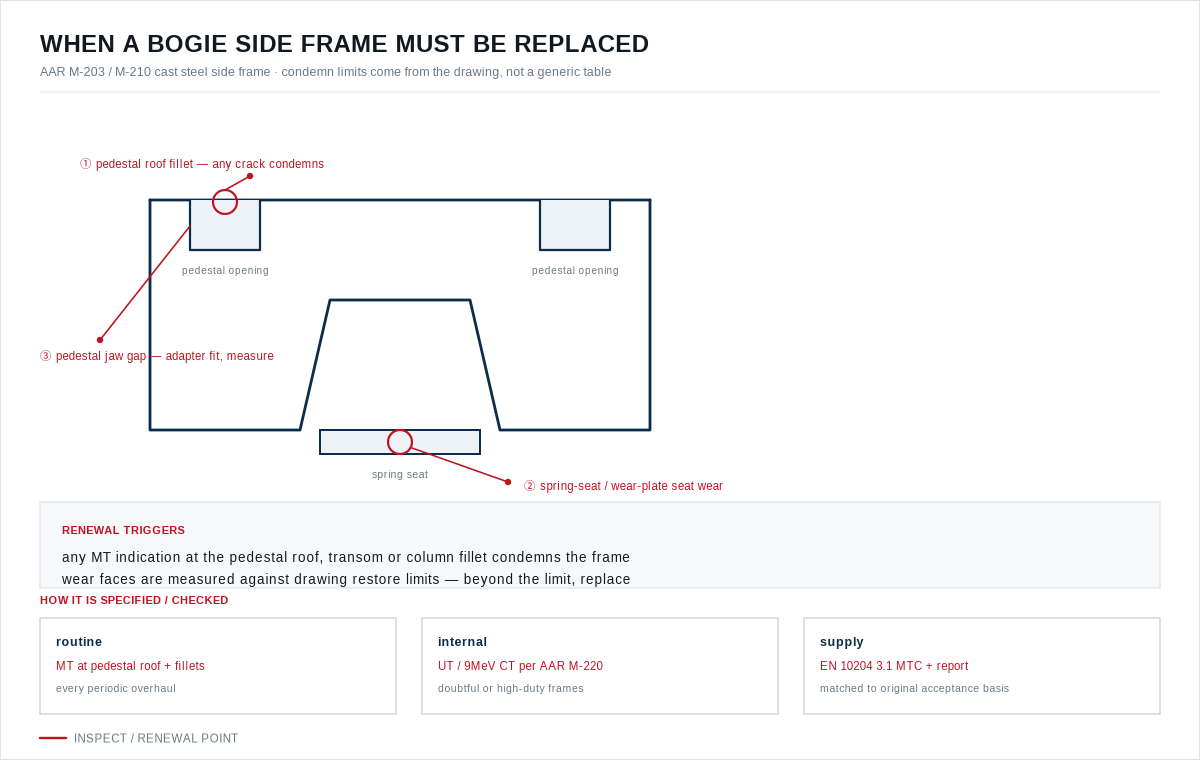
A bogie side frame is condemned and replaced on any crack at the pedestal roof, transom or column fillet, on internal porosity above the soundness limit, or on wear at the wear-plate seat, pedestal jaw or spring nest beyond the stated restoration limit. SIMIS builds side frames to AAR M-203 and M-210; in service the rejection limits are read from the drawing and the operator's maintenance manual, not a generic table.
Side Frame Rejection Criteria: Location, Limit and Detection
The side frame is inspected at every periodic overhaul. This table lists the conditions that condemn a side frame, the measurement or inspection that establishes them, and the AAR reference that applies.
| Failure mode / rejection condition | Consequence or cause | Detection method | Disposition |
|---|---|---|---|
| Crack in the pedestal roof | Any indication | Magnetic particle, UT | AAR M-203 and M-210 |
| Crack in the transom | Any indication | Magnetic particle | AAR M-203 and M-210 |
| Crack at the column fillet | Any indication | Magnetic particle | AAR M-203 and M-210 |
| Wear plate seat wear | Beyond the stated restoration limit | Dimensional measurement | AAR M-210 |
| Pedestal jaw wear | Beyond the stated restoration limit | Dimensional measurement | AAR M-210 |
| Spring nest deformation | Beyond the stated restoration limit | Dimensional measurement | AAR M-210 |
| Internal porosity | Above the internal soundness limit | 9MeV industrial CT | AAR M-220 |
Important. Acceptance limits for wear and dimensional restoration depend on the specific bogie design and on the buyer's own maintenance standard. The values must be read from the drawing and the maintenance manual, not from a general table.
Why These Locations Crack or Wear
The pedestal roof, transom and column fillets concentrate stress from the axle load and from impact at the journal. Any surface-breaking indication there is treated as a reject because a propagating crack in a load path is not a maintenance item. Wear at the plate seat, pedestal jaw and spring nest is gradual and measured; it is restored only to the limit the drawing allows, after which the frame is replaced.
Inspection Equipment and Shop Practice
Shops inspect side frames with magnetic particle (MT) for surface cracks at the critical fillets and with ultrasonic (UT) where the section allows. Internal soundness of suspect or high-duty frames is confirmed by 9MeV industrial CT per AAR M-220. Dimensional wear is measured against the drawing restoration limits. SIMIS supplies new frames with MT/UT reports and the factory material certificate, fully compliant with EN 10204 3.1 so the replacement matches the original acceptance basis.
Acceptance, Records and Replacement
Replacement is recorded against the car and the frame serial and heat numbers. Because acceptance limits follow the drawing and the maintenance manual, the shop must confirm each dimension from those documents. SIMIS keeps the manufacturing records so a replacement frame's test data is retrievable for the contract period.
Frequently Asked Questions
What crack length condemns a side frame?
Under AAR M-203 and M-210 any indication of a crack at the pedestal roof, transom or column fillet condemns the side frame — there is no allowable crack length in the load path. Surface cracks are found by magnetic particle inspection, and any such indication is a reject, because a crack in a structural casting is replaced, not repaired, unless the buyer's written procedure permits welding.
How is a side frame magnetic particle inspected?
The frame is cleaned and subjected to magnetic particle inspection at the high-stress fillets — pedestal roof, transom and column fillets — where a surface-breaking crack would show as a clear indication under UV or visible contrast. SIMIS performs MT on new frames and supplies the report; in-service shops repeat it at each periodic overhaul to catch indications before they propagate.
Which wear surfaces need measurement?
Measure the wear-plate seat, the pedestal jaw and the spring nest against the drawing restoration limits; beyond those limits the frame is replaced. These are the surfaces that lose section under repeated load and impact. Dimensional measurement, not visual judgement, establishes the condemnation, and the exact limit must come from the drawing and the maintenance manual.
Related Reading
- freight wagon side frame casting
- UT vs MT vs radiographic NDT
- railway castings supplier USA and Canada
Request a Quotation
Send your side frame drawing and current maintenance standard to sales@simisrail.com. SIMIS confirms receipt within 1 working day and returns a quotation with indicative lead time and MOQ for replacement frames built to AAR M-203 and M-210.
Technical Review
For a question on side frame rejection criteria, contact Felix at sales@simisrail.com or +86-13934165890.