
Regional supply
Railway Castings for South American Mining Rail
Railway castings supplier for Brazil, Chile and Peru: simplified AAR acceptance, cast steel wheels, coupler systems and wear parts.
Served markets
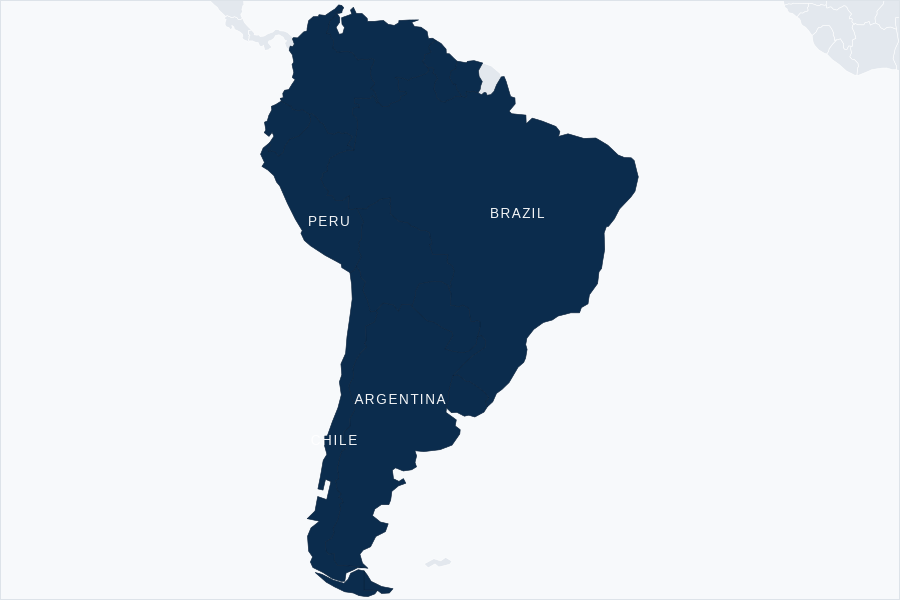
Where these castings ship in South America
Highlighted countries are the markets covered on this page: Brazil, Chile and Peru. Castings are produced in China against the buyer drawing and released with the factory material certificate, fully compliant with EN 10204 3.1.
- Markets covered on this page
- Other countries
SIMIS is a railway castings supplier for Brazil, Chile and Peru, serving severe mining-rail service with simplified AAR acceptance. Our scope covers mining wagon coupler systems, cast steel wheels around 840 mm in diameter, and ZGMn13 high-manganese wear parts for wagon chassis and braking. Brazil runs both 1676 mm and 1435 mm track, while Chile and Peru operate export mining corridors where steep grades and abrasive dust dominate. Every consignment ships with factory material certificate documentation, compliant with EN 10204 3.1 and 100% volumetric NDT. Buyers who need a railway castings exporter for South America get a documented package: castings priced against your drawing, structural and wear parts quoted on separate lines, and each heat lot traceable through the factory material certificate with the heat number on the casting.
Model Families We Supply
South American mining wagons combine structural castings with a high share of wear parts. The table below lists the model families in scope and where each is applied.
| Model family | Typical application |
|---|---|
| Mining wagon coupler | Coupler and draft-gear system for heavy mineral trains |
| Cast steel wheel 840 mm | 840 mm diameter wheel for mining and freight wagons |
| ZGMn13 wear parts | High-manganese liners, cheek plates and wear shoes |
| Friction wedge (ADI/ZGMn13) | Wedge in the three-piece bogie friction suspension |
| Brake beam end / shoe holder | Brake rigging castings for wagon stopping systems |
These families are ordered together more often than separately, because mining operators replace wear parts on a shorter cycle than structural castings. We quote structural and wear parts on separate lines so the cost of each is transparent within the same consignment.
The friction wedge listed above is a bogie casting and is supplied with the bogie castings family; it appears here only because South American buyers often request it together with wear parts.
Standards and Acceptance
South American buyers generally accept a simplified AAR route rather than the full North American interchange package. The key documents for our scope are listed here, with full text and clause references on our standards page.
| Standard | Scope in our supply |
|---|---|
| AAR M-201 | Castings, Steel — grade definition for structural parts |
| AAR M-107 | Wheels, carbon steel — cast steel wheel acceptance |
| AAR M-211 | Couplers and yokes — purchase and acceptance |
| AAR M-269 | Wear plate, coupler carrier — non-metallic performance |
Where a buyer specifies AAR routing we follow the applicable clause; where a national or mining-company specification applies, we supply to that drawing. The acceptance route is confirmed at the quotation stage so there is no ambiguity later.
The South American Mining Context
The South American market is defined by mining haulage: long, steep-grade corridors carrying iron ore and copper, with abrasive dust and high axle loads. Brazil is unusual in running both 1676 mm and 1435 mm track, so gauge compatibility must be checked per order. Wear parts carry a high sensitivity to price, because they are consumed on a short maintenance cycle and dominate the recurring spend.
SIMIS meets this context with German HWS V-process casting, EBT and LF duplex refining, and 9MeV industrial CT/DR inspection. We consolidate structural castings with ZGMn13 wear parts in the same heat lot where specified, and pack for tropical ports with VCI and a moisture barrier. The value we bring is a clear, separated cost breakdown rather than a single opaque mixed figure.
Procurement and Lead Time Matrix for South American Buyers
South American mining buyers order for severe service and place a high weight on price and on the wear parts in the same consignment. This table sets out the sequence and what each step needs.
| Stage | Lead time | Buyer provides | Cost | Notes |
|---|---|---|---|---|
| Drawing review and wear part check | 1 working day | Drawing, grade, service condition | Free | Confirms whether the order needs wear parts alongside the structural castings |
| Technical quotation | 3 working days | Drawing plus quantity and port | Free | Separate lines for structural castings and wear parts |
| First article inspection | 10 to 15 working days | One casting plus the test report | Paid, refundable on repeat orders | Audit level set by the buyer's own team |
| Production | 45 to 60 days | Approved drawing and confirmed sample | 20 to 30 percent deposit | Wear parts in the same heat lot as the structural parts where specified |
| Documentation pack | Issued with the casting | Factory material certificate compliant with EN 10204 3.1, NDT report, dimensional report | Included | English documentation; translation on request |
| Mixed consolidation packing | Held until the order is complete | Consolidation list by weight and volume | Included | Small parts consolidated into mixed LCL kits |
| Sea freight packing | With the order | Packing instruction, VGM | Included | VCI and moisture barrier for tropical ports |
| Shipping | 30 to 45 days by sea | Shipping instruction, documents | Balance against B/L | Destination port nominated by the buyer |
Important. Lead times and deposit terms in this table are indicative. They depend on order size and the current moulding schedule, and a firm date is confirmed in the quotation, not in this table. Price sensitive orders are usually driven by the wear parts rather than the structural castings. Quoting the wear parts separately gives the buyer a clearer cost breakdown than a single mixed figure.
Related Reading for South American Buyers
These articles cover wheels, couplers and wear-part failure modes relevant to mining rail:
- cast vs forged railway wheel
- type E vs type F coupler
- friction wedge wear failure
- brake shoe holder failure
- railway casting RFQ checklist
FAQ
Which wheel size do South American mining wagons use?
Mining wagons in the region commonly run cast steel wheels around 840 mm in diameter, supplied to AAR M-107 acceptance where the buyer specifies AAR routing. Brazil operates both 1676 mm and 1435 mm track, so the gauge and wheel profile are confirmed at the drawing review stage.
Why are wear parts quoted separately for mining orders?
Price-sensitive mining orders are usually driven by the wear parts rather than the structural castings. Quoting the ZGMn13 wear parts on a separate line gives the buyer a clearer cost breakdown than a single mixed figure, and lets the two categories ship in one consolidated consignment.
What standards apply to South American castings?
The regional set is simplified AAR acceptance: AAR M-201 for cast steel, AAR M-107 for wheels, AAR M-211 for couplers and AAR M-269 for non-metallic wear plates. Full clause references are on our standards page.
Request a Quotation
Send your mining wagon drawing, service condition and port to sales@simisrail.com. We confirm gauge and wear-part scope within 1 working day and return a quotation with structural and wear parts on separate lines within 3 working days. Trade terms are quoted on the Incoterms 2020 rule set, with the payment terms, the documentary credit route and the named port stated on the quotation, so the commercial basis is agreed before production starts rather than after it. Documentation is issued in English, and a translated summary can be prepared on request. As a China railway castings exporter for South America, SIMIS Precision Casting Co., Ltd. ships each consignment with the factory material certificate, fully compliant with EN 10204 3.1 certificate, the NDT report and the heat number recorded on every casting, packed for tropical ports with VCI and a moisture barrier. For a technical question, contact Felix at sales@simisrail.com or +86-13934165890.