
Standards & materials
Bottom versus Top Center Plate: Wear, Lubrication and Failure
The lower and upper center plates carry different loads and wear at different rates. Learn which wears faster, how lubrication changes it, and why they.
Published: · Last updated: · Reviewed by Fan Yaoqiang
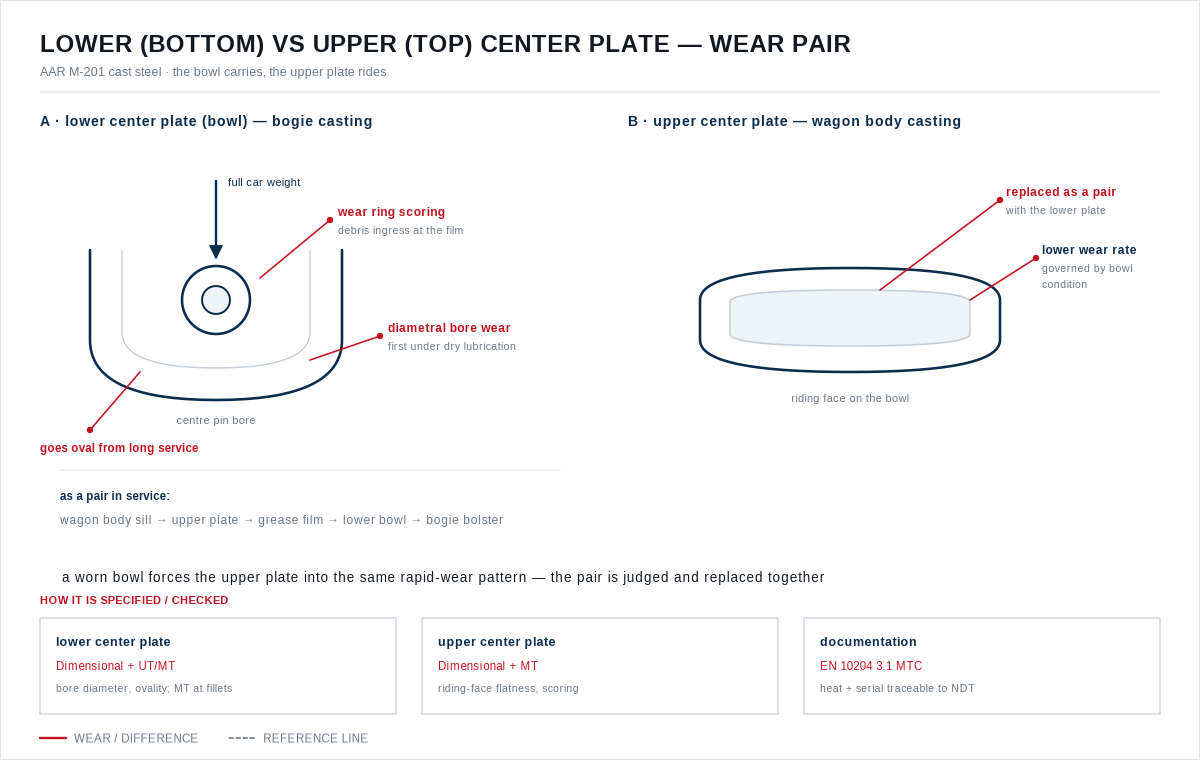
The lower and upper center plates wear differently because they carry different loads and see different lubrication conditions. The lower plate (the bowl) carries the rotating load against the car weight through the centre pin, while the upper plate is the riding face. The two are supplied from different product families: the lower center plate is a bogie casting, and the upper center plate is a wagon body and auxiliary casting that forms part of the vertical load path between the centre sill and the bogie. Both are cast to AAR M-201 steel grades, and they are replaced as a pair.
Lower versus Upper Center Plate
| Aspect | Lower center plate (bowl) | Upper center plate |
|---|---|---|
| Load carried | Full car weight through centre pin | Riding face on the bowl |
| Wear rate | Higher, diametral wear first | Lower, scoring secondary |
| Lubrication condition | Often dry at the interface | Better covered |
| Product family | Bogie castings | Wagon body and auxiliary castings |
| Replacement | With the upper plate, as a pair | With the lower plate, as a pair |
The two plates are a wear pair: the bowl sets the geometry, the upper plate rides it.
Technical Mechanism: Load and Rotation
The center plate assembly sits between the bogie and the car body and lets the body rotate relative to the bogie during.curving. The lower bowl carries the vertical car weight and the reversing rotational load; the upper plate transfers that load across the grease film to the bowl. AAR M-201 defines the casting grade, and the centre pin alignment sets whether the load is shared evenly.
When lubrication is insufficient, the bowl bore wears diametrally and the wear ring scores from debris ingress. Misalignment of the centre pin produces step wear on the plate. Over time the bowl goes oval from long-term service deformation. Because the upper plate rides on the bowl, its wear is governed by the bowl condition; a worn bowl forces the upper plate into the same rapid-wear pattern, which is why the pair is judged and replaced together.
Production Equipment and Process Control
Both plates are poured on the German HWS V-process vacuum sand casting line, which holds the bowl bore and the riding face to the flatness and roundness the rotation geometry needs. EBT + LF duplex refining limits inclusions that would later surface as a fatigue crack at the plate body.
Each casting is verified by 9MeV industrial CT/DR volumetric scanning and by UT/MT/PT before CNC machining of the bearing face. Normalising and tempering delivers the toughness the reversing load demands, with furnace records tied to the heat number.
Inspection, Acceptance and Traceability
Every center plate ships with the factory material certificate, fully compliant with EN 10204 3.1, a heat number and an individual serial number. NDT reports are filed against that serial so a depot can trace a worn or cracked plate back to its melt and inspection record.
Because the lower and upper plates are a pair, SIMIS supplies them against the same bogie type and heat lot the fleet runs, so the bowl and riding face are matched at fitting rather than discovered to mismatch in service.
Typical Failure Modes and Detection Methods
The lower and upper center plates wear differently because they carry different loads and see different lubrication conditions. This table maps the failure mode to its cause and to the inspection that identifies it.
| Failure mode / rejection condition | Consequence or cause | Detection method | Disposition |
|---|---|---|---|
| Diametral wear on the bowl | Normal service rotation with dry lubrication | Dimensional measurement of the bowl bore | Restore or replace |
| Step wear on the centre plate | Misalignment of the centre pin | Dimensional measurement | Replace the plate and check centre pin alignment |
| Scoring on the wear ring | Debris ingress, insufficient grease | Visual | Replace the wear ring, improve sealing |
| Crack at the centre plate body | Fatigue from reversing load | Magnetic particle, UT | Replace |
| Bowl ovality | Long term service deformation | Dimensional measurement | Replace |
| Premature wear with heavy grease | Over lubrication carrying grit to the interface | Dimensional measurement and grease analysis | Adjust the lubrication interval, not the material |
Important. Lower and upper center plates should be replaced as a pair. A new upper plate running against a worn lower bowl gives the same rapid wear pattern that the new plate was intended to fix.
FAQ
Which center plate wears faster and why?
The lower center plate (the bowl) usually wears faster because it carries the rotating load against a dry or poorly lubricated interface and sees the full car weight through the centre pin. Diametral wear on the bowl bore is the first measurable loss; the upper plate wears more slowly as the riding face, so the pair should be judged together.
How does lubrication change wear rates?
Lubrication reduces the friction at the rotating interface and slows diametral and scoring wear, but over-lubrication carries grit into the interface and causes premature wear. The right interval, not more grease, controls the rate; a grease analysis at inspection tells whether the interval, not the material, is the problem.
Should both plates be replaced together?
Yes. Lower and upper center plates should be replaced as a pair. A new upper plate running against a worn lower bowl reproduces the rapid wear the new plate was meant to fix, so the pair is condemned and fitted together rather than one face at a time.
Related
CTA
Send your center plate drawing with the bogie type to sales@simisrail.com. SIMIS confirms receipt within 1 working day and returns a quotation within 3 working days, stating pair supply, indicative lead time and MOQ.
Technical Review
For a question on the lower and upper center plate, contact Felix at sales@simisrail.com or +86-13934165890.