
Couplers & draft gear
SA-3 vs AAR Draft Gear: Force Paths and Performance
SA-3 loads the draft gear in both directions; AAR bypasses it under draft. Compare Р-2П, MT-2, MT-3 and Mark 50: strokes, capacity and structure.
Published: · Last updated: · Reviewed by Hou Zhiling
Both the SA-3 and AAR coupler systems end in the same hardware — a coupler, a draft gear, follower plates and a striker — but they load that hardware differently. In the SA-3 arrangement the draft gear is a through-type element: draft force passes through the draft yoke into the gear and bears on the striker, and buff force compresses the same gear through the front and rear follower plates. In the AAR arrangement the draft gear works only in compression: draft force bypasses it through the yoke and follower directly onto the strikers, and the gear absorbs energy only when cars buffer.
SA-3 cushioning: rubber stacks and friction packages
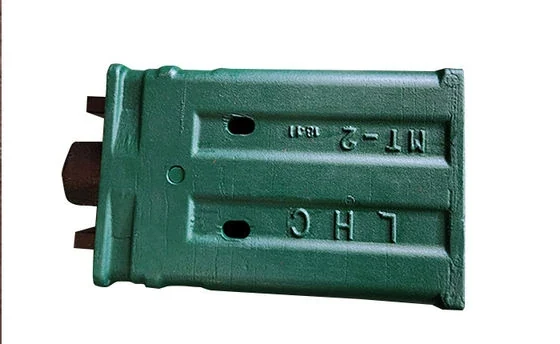
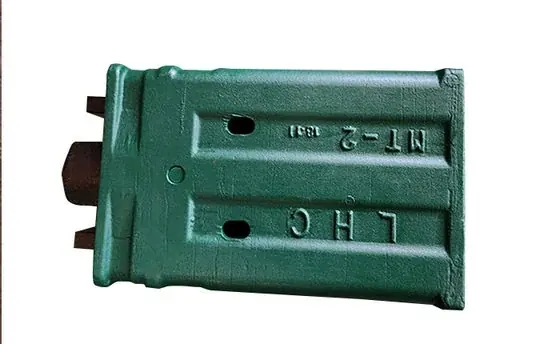
The classic SA-3 draft gear is the Р-2П — a rubber-metal block of rubber layers vulcanized onto steel plates, used mainly in passenger stock. It is simple and carries no wearing parts to replenish; the rubber is frost-resistant, though its initial stiffness rises in deep frost. The typical stroke is about 70 mm with energy absorption of 0.38–0.45 depending on the source. The historical freight baseline is the Ш-1-ТМ series; for heavy-haul programmes the friction family MT-2 and MT-3 (friction wedges with inner and outer coil springs in a steel case) raises capacity to 50 kJ and more at a stroke of about 80 mm; the two designs are compared in the MT-2 vs MT-3 note.
AAR cushioning: friction wedges and polymer springs
North American practice is built on the Mark 50 and SL-76 families: all-steel friction wedge units with steel or polymer springs, some versions carrying a rubber-steel centre elastomer. Typical capacities run 15–35 kJ at strokes of 40–50 mm; the heavy-haul Mark 50 reaches 52.7 kJ with an 82.5 mm stroke and absorbs around 80% of the input energy. Premium gas-liquid units for the most demanding services exceed 350 kJ.
Side-by-side comparison
| Characteristic | SA-3 Р-2П | AAR Mark 50 |
|---|---|---|
| Core element | rubber-metal elastic stack | steel friction wedges + steel spring |
| Stroke | ~70 mm | 82.5 mm |
| Capacity | ~20 kJ | 52.7 kJ |
| Weight | 116 kg | 175 kg |
| Energy absorption | 0.38–0.45 | ~80% |
| Operating environment | 1520 mm gauge | 1435 mm gauge |
Energy absorption figures follow published sources and depend on the loading regime; other gear families differ.
Layout: a box in the sill versus a package in the yoke
The Р-2П is a rectangular box set into the draft sill space between the follower plates and the striker — no bypass members are needed because the gear carries load in both directions. The AAR draft gear sits inside the yoke cavity between the two strikers; the yoke frame carries draft force past the gear, so the gear itself can be a compact single-purpose compression unit.
Which standard fits heavy haul?
Capacity follows axle load, and both systems have answered it: the 1520 mm fleet moved from Ш-1-ТМ-class units to MT-2/MT-3 friction packages, while the 1435 mm heavy-haul fleet standardised on Mark 50-class units. The real selection criterion is the coupler system of the fleet the car will join — the draft gear, follower plates and striker must match that system’s drawings. SIMIS casts draft gear housings and cases, front and rear follower plates, coupler strikers and yokes for both families: to customer drawings and TU for 1520 mm gauge programmes, and to the AAR M-201 series for AAR programmes.
How are draft and buff forces transmitted in the SA-3 and AAR arrangements?
In the SA-3 arrangement the draft gear is loaded in both directions: draft force passes through the draft yoke into the gear and bears on the striker, while buff force flows through the front and rear follower plates. In the AAR arrangement draft force bypasses the draft gear through the yoke and follower directly onto the strikers, and the gear is compressed only under buff.
Which draft gear fits wagons of 1520 mm gauge?
The Р-2П rubber-metal gear is used mainly in passenger stock: a stroke of about 70 mm and absorption of 0.38–0.45 depending on the source. Freight wagons use the Ш-1-ТМ series as the baseline, and heavy-haul programmes move to MT-2 or MT-3 friction gears of 50 kJ capacity and more with a stroke of about 80 mm. All fit the same space between the follower plates and the striker.
Does SIMIS cast draft gear components for both systems?
Yes. SIMIS casts draft gear housings and cases, front and rear follower plates, coupler strikers and yokes — to customer drawings and TU for 1520 mm gauge programmes and to the AAR M-201 series for AAR programmes.