
Blog
Railway Casting Technical Notes — Page 6 of 6
Engineering notes on material equivalency, standards, casting failure and process control — the questions that surface after the first RFQ, answered in advance.
Blog
47 technical notes — Page 6 of 6
Practical answers for buyers of railway cast steel — eight notes per page.
- Standards & materials
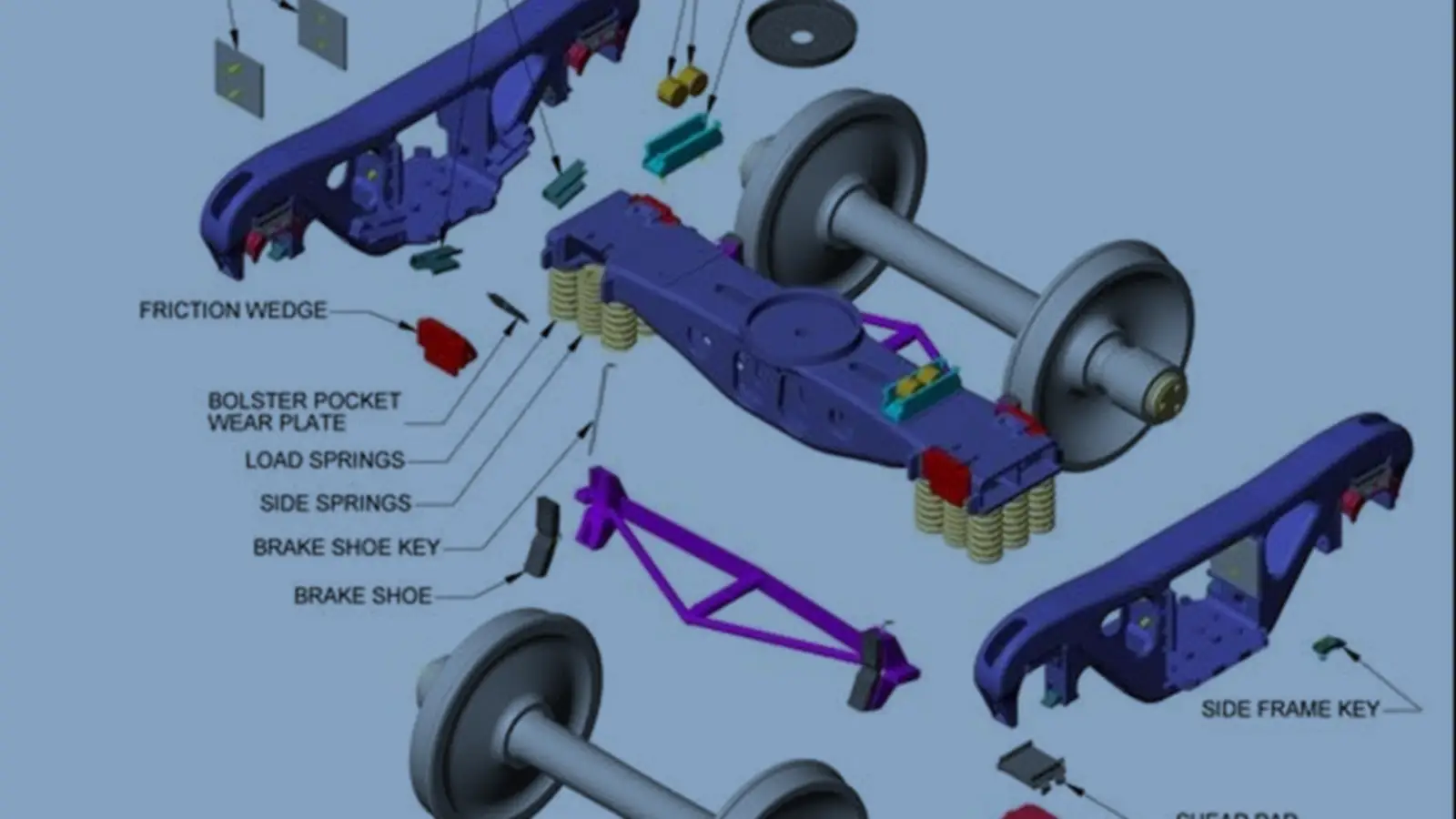
Why Heavy-Haul and Mining Wagons Use Three-Axle Bogies
Why heavy-haul, mining and heavy tank wagons use three-axle bogies: how three axle positions spread the load, and why the crossbeam is hard
- Sourcing & markets
TR CU 001/2011: Certification for EAEU Railway Castings
TR CU 001/2011 is the EAEU technical regulation covering railway products. Learn the documents, declarations and EAC marks casting suppliers
- Process & products
Type E vs Type F Couplers: Interchangeability and Limits
Type E and Type F couplers share the AAR automatic head but are not knuckle-interchangeable. Learn the limits and spare-part strategy.
- Quality & inspection
UT, MT, PT or Radiography: Which NDT for Which Casting?
Ultrasonic, magnetic particle, penetrant and radiographic testing each suit different rail casting flaws. Learn which method fits thick sect
- Failure & inspection
When to Replace a Bogie Bolster: Rejection Criteria
A bogie bolster is replaced on any crack at the side-frame connection, centre bowl or wedge pocket, or on wear beyond the restoration limit.
- Failure & inspection
When to Replace a Bogie Side Frame: Criteria and Limits
A bogie side frame is replaced on any crack at the pedestal roof, transom or column fillet, or on wear beyond the restoration limit. See AAR
- Process & products
Why Do Draft Gear Housings Require EBT and LF Duplex Refining?
Why draft gear housings need EBT and LF duplex refining for buff-shock resistance. Clean steel, impact toughness, and the two-furnace route
- Failure & inspection
Why Do Railway Bogie Bolsters Crack? Causes and Prevention
Why railway bogie bolsters crack in service: crack locations, the role of casting porosity, and how V-process molding and 9MeV CT prevent fa